ExploreChileliving unforgettable adventures


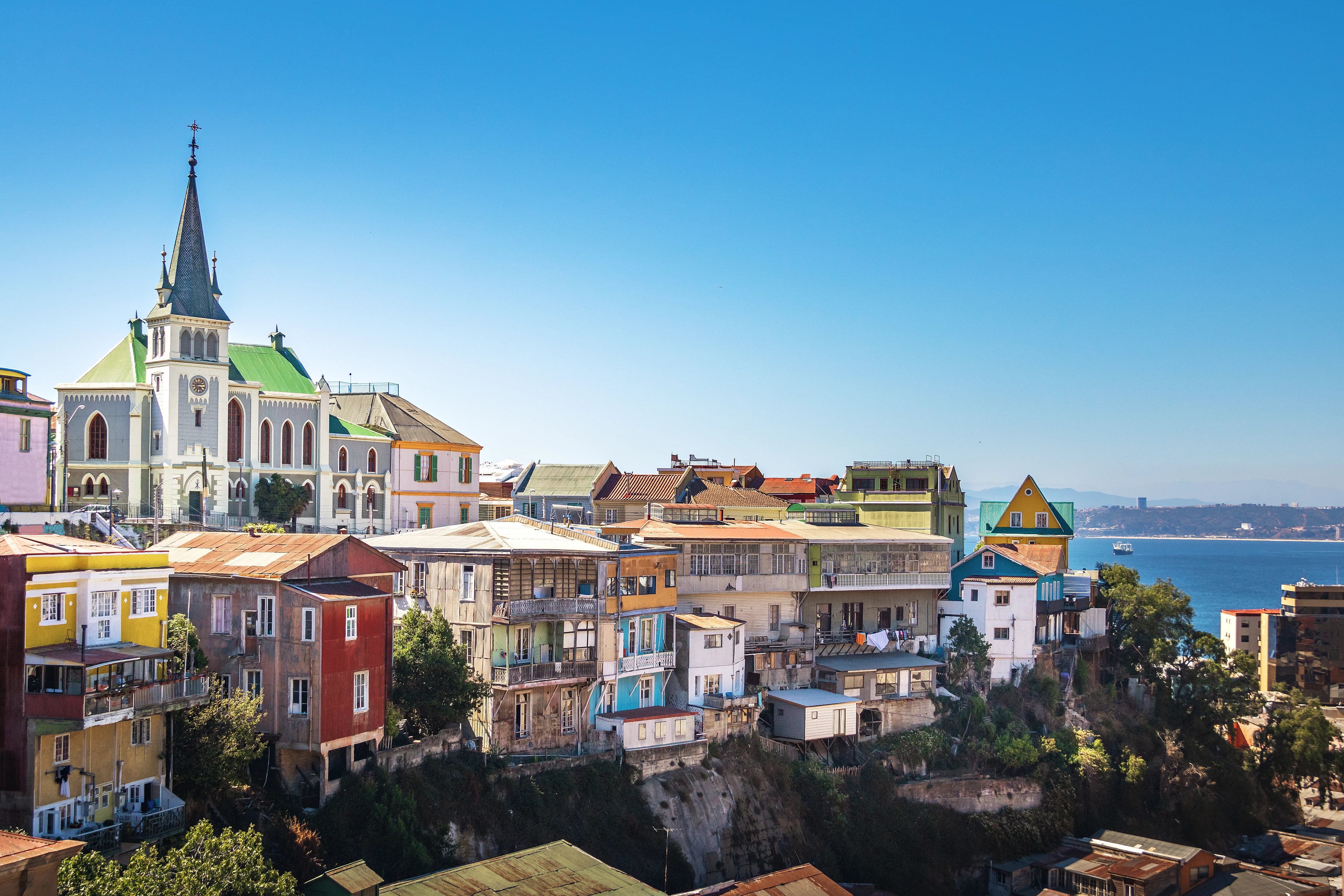
Valparaíso
The Valparaíso Region is Chile's cultural and coastal jewel, anchored by the UNESCO-listed port city of Valparaíso, a labyrinth of colourful hillside houses, century-old funicular elevators, and vibrant street art. Pablo Neruda's La Sebastiana house overlooks the bay, and the city's bohemian nightlife and New Year's fireworks are legendary.
Audio version available
Valparaíso, The Jewel of the Pacific
Valparaíso is unlike any other city in Chile. Built on 42 cerros (hills) that tumble steeply to the harbour, it is a vertical city where century-old ascensores, funicular elevators, rattle up cliff faces alongside graffiti-covered staircases and winding alleyways that open suddenly onto breathtaking ocean views. The city's historic quarter, inscribed as a UNESCO World Heritage Site in 2003, preserves the architectural legacy of its golden age as the Pacific's premier port: Victorian warehouses, Art Nouveau mansions, and the oldest stock exchange in Latin America.
Today, Valparaíso is Chile's bohemian capital, a city of poets, artists, and musicians where Pablo Neruda's house La Sebastiana still watches over the bay, and every wall, staircase, and alley seems to serve as a canvas for muralists from around the world.
Its New Year's Eve fireworks display, launched from the harbour and the hillsides simultaneously, is one of the largest in the Americas.
Viña del Mar, The Garden City
Just across the Marga Marga estuary from Valparaíso, Viña del Mar could not be more different from its bohemian neighbour. Known as the Ciudad Jardín (Garden City), it is a manicured resort town of palm-lined boulevards, beachfront high-rises, and the Quinta Vergara park, whose amphitheatre hosts the Festival Internacional de la Canción, Latin America's most prestigious music festival, each February.
The Flower Clock on the waterfront has become one of Chile's most photographed landmarks, while the grand Casino Enjoy and the nearby Reñaca beach draw holidaymakers from Santiago on summer weekends.
Viña's restaurants, from traditional seafood joints to upscale contemporary dining, benefit from the region's dual identity: the freshest Pacific catch combined with wines from the Casablanca and Aconcagua valleys just over the coastal hills.
Casablanca and Aconcagua, Cool-Climate Wine Country
The valleys behind the coast have transformed the Valparaíso Region into one of Chile's most exciting wine destinations. The Casablanca Valley, discovered for viticulture only in the 1980s, is now synonymous with crisp Sauvignon Blancs, elegant Chardonnays, and cool-climate Pinot Noirs that rival those of Burgundy in finesse.
Morning fog from the Pacific keeps temperatures low, producing wines with a bright acidity that has won international acclaim. Further inland, the warmer Aconcagua Valley excels with bold Cabernet Sauvignons and Syrahs, and the high-altitude Aconcagua Costa sub-region is pushing the boundaries of Chilean viticulture into increasingly marginal terrain.
The wine route between these valleys passes through rolling hills dotted with boutique estates, many of which offer tastings, on-site restaurants, and harvest-season experiences that combine gastronomy with panoramic views of vine-covered slopes stretching to the Andes.
Portillo, Andes Adventures, and Inland Escapes
The Valparaíso Region's Andean hinterland offers some of Chile's most accessible mountain adventures. Portillo, perched at 2,860 metres beside the Laguna del Inca, a turquoise lake steeped in Inca legend, is Chile's oldest and most iconic ski resort, famous for the steep chutes that have hosted multiple World Cup speed-skiing records.
In summer, the same mountains offer trekking, rock climbing, and mountain biking through valleys where condors soar above herds of wild guanacos. The town of Los Andes, gateway to the Paso Los Libertadores border crossing to Argentina, preserves a charming colonial centre and serves as a base for exploring the surrounding foothills.
The Río Blanco nature sanctuary, a high-altitude wetland, is home to foxes, eagles, and rare Andean cats, offering wildlife encounters within a short drive of the urban coast.
Easter Island and the Juan Fernández Archipelago
The Valparaíso Region extends far into the Pacific to encompass two of the world's most extraordinary island groups. Easter Island (Rapa Nui), 3,700 kilometres offshore, is home to the enigmatic moai, nearly 900 monolithic stone statues carved by the Polynesian Rapa Nui people between the 13th and 16th centuries, standing as silent guardians along the volcanic coastline.
The island's Polynesian culture, unique in Chilean territory, survives in the Tapati festival, the ahu ceremonial platforms, and a language still spoken by several thousand islanders. Closer to the mainland but equally remote, the Juan Fernández Archipelago, where the marooned sailor Alexander Selkirk inspired Daniel Defoe's Robinson Crusoe, shelters one of the world's highest concentrations of endemic plant species per square kilometre, along with the Juan Fernández fur seal and the tiny rayadito bird found nowhere else on Earth.
Points of Interest
Cities
Cities
Valparaíso
Chile's principal port and one of its most singular cities (population around 300,000), UNESCO-listed since 2003 for an extraordinary urban landscape of steep cerros, brightly painted clapboard houses and 19th-century funiculars that still climb between the neighbourhoods. Founded in 1544, Valparaíso became South America's most important Pacific harbour before the opening of the Panama Canal, drawing British, German and Italian traders whose descendants shaped its cosmopolitan character. The bohemian bar district around Cerros Concepción and Alegre, the poet Pablo Neruda's house 'La Sebastiana', and the National Congress (which relocated here after the return to democracy) all sit within a walkable core.
Cities
Viña del Mar
'Ciudad Jardín' (Garden City) of around 330,000 that grew up along the beaches just north of Valparaíso, and Chile's best-known coastal resort. Founded in 1874, Viña became fashionable in the late 19th century when Santiago's wealthy families built summer palaces along its coastline; the Wulff Castle, the Palacio Rioja and the ornate Casino Municipal all date from that era. The Reloj de Flores (a working flower clock) at the entrance, the annual Festival Internacional de la Canción, and a broad string of Pacific beaches make it Chile's postcard beach town.
Cities
Zapallar
An exclusive coastal village of around 7,000 on Chile's central coast, considered by many the country's most sought-after beach resort. Zapallar was founded in 1893 when Olegario Ovalle donated coastal land on the condition that only fine houses in a coherent architectural style be built there; the result is a horseshoe bay ringed by grand villas set among Monterey pines, with no boardwalk and no high-rises. The tiny cove and Playa Zapallar sit at the town's centre, and the caleta pescadora at one end still lands the daily catch consumed at the excellent seafood restaurants above the beach.
Cities
Algarrobo
Coastal town of around 15,000 south of Valparaíso, best known internationally for San Alfonso del Mar, holder of the Guinness record for the world's largest swimming pool, a saltwater lagoon over a kilometre long that turns the resort into its own crystalline sea. Beyond the record-holder, Algarrobo is a classic weekend escape for Santiaguinos, with sheltered beaches, an active yacht club, and the small Isla Pájaros Niños just offshore — a breeding colony of Humboldt penguins, jotes and cormorants.
Cities
Cartagena
Coastal town of around 20,000 on the San Antonio shore, once the most fashionable beach resort in central Chile and still lined with the wooden balconied houses of that era. Its steep streets drop to a curving bay, and the poet Vicente Huidobro is buried on the hillside above the sea, under an epitaph he wrote himself. The town's faded belle-époque character has made it a favourite subject for Chilean photographers and filmmakers.
Cities
Hanga Roa
The only town on Easter Island (Rapa Nui), 3,700 km west of the Chilean mainland, and one of the world's most remote inhabited settlements (population around 7,000). Hanga Roa is the gateway to the island's roughly 900 moai — the monolithic stone ancestors carved by the Rapa Nui people between the 13th and 16th centuries — along with the ceremonial ahu platforms, the Rano Raraku volcano quarry where the statues were sculpted, and the Orongo ritual village on the cliff above Rano Kau. Rapa Nui culture, Polynesian in origin and unique within Chilean territory, endures in the Tapati festival each February, a living language, and the petroglyphs that mark the whole island.
Natural Reserves
Natural Reserves
Parque Nacional La Campana
UNESCO Biosphere Reserve inland from Viña del Mar, protecting one of the largest surviving Chilean palm (Jubaea chilensis) forests. The Cerro La Campana peak was climbed by Charles Darwin in 1834, an experience he later called 'the most enjoyable day' of his Beagle voyage.
Daily 9:00–17:30 · CLP 5,000
Hiking · Wildlife
Natural Reserves
Reserva Nacional Lago Peñuelas
Reservoir and forest reserve between Valparaíso and Casablanca, historically Valparaíso's main water supply. Native and planted forests around the lake support otters, black-necked swans, and over 100 bird species; well-marked hiking trails circle the shoreline.
Daily 9:00–17:30 · CLP 3,000
Hiking · Wildlife · Camping
Natural Reserves
Reserva Nacional El Yali
Coastal wetland complex south of Santo Domingo, a Ramsar-listed site holding one of central Chile's most important concentrations of migratory waterbirds, over 130 species including flamingos, black-necked swans, and coscoroba swans. Salt lagoons and dunes stretch along the Pacific.
Open all year · Free
Wildlife · Hiking
Natural Reserves
Monumento Natural Isla Cachagua
Small rocky islet just offshore from Zapallar, home to a breeding colony of Humboldt penguins along with kelp gulls, cormorants, and pelicans. Access to the island itself is restricted; visitors view the colony from Zapallar and Cachagua beaches or by boat.
View from coast · Free
Wildlife
Natural Reserves
Dunas de Concón
Coastal dune field at the mouth of the Aconcagua River, on the northern edge of Concón. Declared a nature sanctuary in 1994, the dunes offer paragliding, panoramic ocean views, and one of the most photographed sunsets on the central Chilean coast.
Open all year · Free
Hiking
Natural Reserves
Centro de Esquí Portillo
Legendary ski resort at 2,880m on the high Andean pass between Chile and Argentina, near the Cristo Redentor tunnel. Founded in 1949, Portillo hosted the 1966 FIS Alpine World Ski Championships, the only time the event has been held in South America. The bright-yellow Hotel Portillo and Laguna del Inca are its icons.
Winter season (Jun–Oct)
skiing · Lodging · Restaurant
Natural Reserves
Parque Nacional Juan Fernández
UNESCO Biosphere Reserve covering the Robinson Crusoe archipelago, 670 km west of the mainland. The islands where marooned sailor Alexander Selkirk lived 1704–1709 (inspiring Defoe's novel) hold one of the world's highest densities of endemic plants and the Juan Fernández fur seal, once thought extinct.
Open all year · CLP 5,000
Hiking · Wildlife
Natural Reserves
Parque Nacional Rapa Nui
UNESCO World Heritage park covering most of Easter Island (Rapa Nui), 3,700 km west of the mainland. Protects the roughly 900 moai and their ceremonial ahu platforms, the Rano Raraku statue quarry, and Orongo cliff village. Ticket required for all archaeological sites.
Daily 9:00–19:00 · USD 80 (foreigners)
Hiking · Wildlife
Natural Reserves
Ahu Akivi
Inland ceremonial platform on Easter Island with seven identical moai, unique among the roughly 300 restored ahu for facing the sea rather than turning their backs to it. Local tradition holds that the seven statues represent the scouts sent by the ancestral king Hotu Matu'a to explore the island.
Daily 9:00–19:00
Natural Reserves
Ahu Tongariki
The largest ceremonial platform on Easter Island, with 15 restored moai lined up along the eastern coast under Rano Raraku volcano. Toppled by a 1960 tsunami and re-erected in the 1990s with Japanese support, Tongariki is the island's most photographed sunrise view.
Daily 9:00–19:00
Natural Reserves
Orongo y Rano Kau
Ceremonial village of stone houses perched on the rim of the Rano Kau crater at the southwestern tip of Easter Island. Orongo was the centre of the tangata manu ('birdman') cult that succeeded the moai era; competitors swam to Motu Nui islet to bring back the first sooty tern egg of the season.
Daily 9:00–19:00
Natural Reserves
Playa Anakena
Small crescent of white coral sand on Easter Island's north coast, backed by a grove of coconut palms and the beautifully restored Ahu Nau Nau. Rapa Nui tradition places the landing of Hotu Matu'a, the island's ancestral king, on this beach.
Open all year
Natural Reserves
Te Pito Kura
Site on Easter Island's north coast holding the toppled Paro moai, the largest ever successfully transported and erected on an ahu (nearly 10 m tall). A short walk away sits a smooth magnetic stone the Rapa Nui called 'Te Pito o Te Henua', 'the navel of the world'.
Daily 9:00–19:00
Wineries
Wineries
Viña Casas del Bosque
Viña Casas del Bosque was founded in 1993 by the Cúneo family, of Italian heritage, at the Las Dichas estate in the Casablanca Valley. The location tells most of the story: 70 km west of Santiago, 40 km inland from the port of Valparaíso and only 18 km from the Pacific, so cool morning marine air, sharp day-to-night temperature swings and 110-million-year-old granite soils give the vineyards the terroir behind Chile's finest cool-climate whites. The estate now works 134 hectares planted mostly to cool-climate varieties, Sauvignon Blanc, Chardonnay, Riesling, Pinot Noir, Syrah, Malbec and Cabernet Franc, complemented by Cabernet Sauvignon and Carménère brought in from the warmer Maipo, Colchagua and Cachapoal valleys for the reds. Annual production runs to roughly 1.3 million litres (140,000 cases), exported to more than fifty countries. The winery holds a sustainable-vineyard certification, runs an organic orchard alongside the vines, and appears regularly among Chile's top houses in World's Best Vineyards. Visits are built as full estate days rather than quick tastings. Multiple tour and tasting formats, La Trampa Premium, Aromas, Private, are paired with three restaurants (Tanino, Botánico and Casa Mirador, the last a Wine Access recommendation), a working organic orchard and the Tranque Los Olivos lake. Chef-led cooking classes, harvest participation, helicopter flyovers, guided bike tours and picnic experiences round out one of the Casablanca Valley's most complete wine-tourism programmes.
Mon–Sun 10:00–18:00
Wine Tasting · Tours · Shop · Restaurant
Wineries
Viña Matetic
Matetic Vineyards traces its family history to 1892, when Jorge Matetic Cetinja arrived in Chile from Fiume (today Rijeka, Croatia) and put down roots in the country's coastal hills. Four generations later the family founded the winery in 1999 at the Valle del Rosario estate, a coastal valley wedged between Casablanca and San Antonio, and celebrated its first harvest in 2001. The location was chosen for its cool ocean-influenced climate, and it quickly became the launchpad for one of Chile's boldest bets: pioneering commercial cold-climate Syrah in the country. The estate spans 160 hectares, all Demeter-certified biodynamic since 2013 (organic certification came earlier, in 2004), planted principally to Syrah, Sauvignon Blanc, Chardonnay and Pinot Noir. The gravity-flow cellar, built in 2003 from regional materials, was designed around the winery's guiding philosophy of 'amor hacia la tierra' and shaped with input from the late American biodynamic consultant Alan York. The two headline tiers, the pioneering EQ line launched with the 2001 vintage and the Matetic Syrah at the top, have collected recognitions few Chilean cool-climate reds can match, EQ Syrah 2004 made Wine Spectator's Top 100 in 2006, and Tim Atkin's 2013 report scored the Matetic Syrah 98 points and named it Best Red of the Year. A visit is designed as a full-day, and often overnight, immersion. Guided tours walk through the biodynamic vineyards and the gravity-flow cellar, tastings run across the EQ, Corralillo and Matetic labels, and the Restaurante Equilibrio pairs regional cooking with the estate wines. Hotel Boutique La Casona, opened in 2004 in a restored country house at the heart of the estate, extends the experience with agritourism stays, horseback rides and bike tours across the vineyards, one of Chile's most complete rural wine-tourism programmes and a perennial fixture on international best-of lists.
Mon–Sun 10:00–18:00
Wine Tasting · Tours · Shop · Restaurant · Lodging
Wineries
Viña Veramonte
Veramonte was born in the late 1980s when Agustín Huneeus, a pioneer of modern Chilean wine, gambled on the then-unheralded Casablanca Valley by planting 40 hectares of Sauvignon Blanc at a time when barely 25 hectares of vine existed in the whole valley. The estate delivered its first wines in the mid-1990s and quickly became a reference point for what Chile could do with white wines grown a stone's throw from the Pacific. In 2015 the winery joined the portfolio of González Byass, the Spanish sherry family founded in Jerez in 1835 and now in its fifth generation, cementing an already-strong international identity. Today Veramonte works two contrasting terroirs: the cool coastal Casablanca Valley for Sauvignon Blanc, Chardonnay and Pinot Noir, and warmer Marchigüe in Colchagua, 45 km from the ocean, for Merlot, Syrah, Carménère and Cabernet Sauvignon. All vineyards are farmed organically and biodynamically, and the properties are wrapped by more than 2,500 hectares of preserved native forest, a rare buffer of native flora and fauna around a Chilean commercial vineyard. The house's flagship 'Sostenibilidad 360°' programme extends the philosophy of 'suelos vivos' (living soils) to soil regeneration, biodiversity and a community-garden initiative launched in 2018 with the Casablanca municipality to support smallholder farmers. Two brands carry the portfolio: Veramonte (Reserva and Gran Reserva tiers from Casablanca and Colchagua) and Ritual, the premium expression from the organic Casablanca vineyards, both led by winemaker Sofía Araya. Visits centre on Casona Veramonte in Casablanca, open every day 9:00–18:00. Guided tastings walk through the Veramonte and Ritual ranges, tours take in the vineyards and the native forest that surrounds them, and picnic experiences under the trees pair the whites with regional produce. The cellar is a common stop on Casablanca Valley wine routes for its combination of scale, sustainability credentials and easy access from the coast highway to Valparaíso.
Mon–Sun 10:00–18:00
Wine Tasting · Tours · Shop
Wineries
Viña Indómita
Viña Indómita was founded in 2001 by the Del Pedregal family and quickly became one of the most photographed wineries in Chile: a white castle-like silhouette perched high above Ruta 68 in the Casablanca Valley, between Santiago and Valparaíso, visible for miles as you drive down toward the coast. The barrel cellar is dug into the hillside itself, and the tower rising over the valley delivers one of the most celebrated sunset views along the Casablanca wine route. In 2006 the winery was acquired by the Chilean Bethia Group, and in 2017 the Chinese giant Changyu bought 85% of the operation, giving rise to Indomita Wine Group and cementing an already-strong export presence in more than forty countries. The estate now works two contrasting terroirs: 150 hectares in cool coastal Casablanca for Sauvignon Blanc, Chardonnay, Pinot Noir and Syrah, and 350 hectares in the warmer Maipo Valley for Cabernet Sauvignon, Carménère, Syrah and Merlot. Portfolio tiers run from the everyday Varietal line up through Reserva, Gran Reserva and Duette (single-vineyard), and top out with the flagship Zardoz Cabernet Sauvignon, one of the country's better-known ultra-premium bottlings. Growth has been the story: within two decades the house moved from a young project to one of Chile's highest-selling wineries at home and among its most active exporters. Visits centre on the hillside wine-tourism complex and its glass-walled restaurant overlooking the valley. Guided tours and tastings walk through the Varietal, Reserva, Gran Reserva and Zardoz labels, the wine shop carries the full range, and the terrace is a popular late-afternoon stop for locals driving up from Valparaíso to catch the sunset. Its combination of theatrical architecture, quick access from Ruta 68 and consistently well-priced whites has made Indómita one of the most-visited wineries in the Casablanca Valley.
Mon–Sun 10:00–18:00
Wine Tasting · Tours · Shop · Restaurant
Wineries
Viñamar de Casablanca
Viñamar de Casablanca is Chile's sparkling-wine specialist, housed in Casa Valle Viñamar, the imposing white estate that stands at km 72 of Ruta 68, just before you reach the town of Casablanca on the way from Santiago to Valparaíso. The building was originally conceived as a boutique hotel and today serves as one of the country's most photographed cellar doors, its Moorish-inflected white walls and lush gardens visible for miles from the highway. Viñamar belongs to VSPT Wine Group, born of the 2008 merger of Viña San Pedro (1865) and Viña Tarapacá (1874), and shares the group with sister houses Leyda, Santa Helena and Misiones de Rengo. The estate covers 274 hectares in the coastal Casablanca Valley, cooled every afternoon by the Pacific breeze and complemented by fruit sourced from the neighbouring Leyda Valley. The still-wine range draws on Sauvignon Blanc, Merlot, Cabernet Franc and Carménère, but the house's identity is built on sparkling wine. Since 2010, when it launched its first trio (Método Tradicional, Brut and Demi Sec), Viñamar has expanded a portfolio that today counts eight sparklers, adding Rosé, Extra Brut, Brut Unique, the pour-over-ice Viñamar ICE (2017) and Moscato Unique (2019). The flagship Método Tradicional undergoes its second fermentation in bottle and is blended from Pinot Noir, Riesling and Garganega, an unusual varietal mix that gives it a distinctive Casablanca character. Visits centre on the manicured gardens, the tasting room and the acclaimed Macerado restaurant, whose broad terrace overlooks the vineyards. Guided tours walk through the sparkling-wine cellar and its traditional-method production, tastings run across the eight bubbles and the still-wine range, and lunch at Macerado is one of the best-known food-and-wine pairings on the Casablanca circuit. The combination of striking architecture, easy access from Ruta 68 and pure focus on sparkling wine has made Viñamar one of the most-visited wineries in the Casablanca Valley.
Mon–Sun 10:00–18:00
Wine Tasting · Tours · Shop · Restaurant
Wineries
Viña Emiliana
Viña Emiliana was founded in 1986 by the Guilisasti brothers, Rafael and José, and starting in 1998 they set the winery on a path few Chilean producers had considered at the time: a full conversion of the vineyards to organic and biodynamic farming, in partnership with agronomist Álvaro Espinoza. By 2001 Emiliana had become the first Chilean and seventh global winery certified to ISO 14001 and had earned organic certification from Switzerland's IMO. Today it is regarded as the world's largest organic-certified winery, farming nearly 1,200 hectares of land across the Casablanca, Maipo, Colchagua and Cachapoal valleys. Of those, close to 997 hectares are planted with vines, 923 already IMO-certified organic and the remainder in conversion. Certifications have piled up alongside the farming philosophy: Demeter biodynamic in 2006, CarbonZero carbon-neutral in 2009 (renewed 2014), Fair Trade in 2011, Vegan Society in 2019 and the pioneering Regenerative Organic (ROC) certification in 2023. The portfolio is anchored by the flagship Coyam, a Colchagua six-grape blend led by Syrah and Cabernet Sauvignon and aged 13 months in French and American oak, born of the biodynamic Los Robles estate that has become a model of reference for visiting viticulturists worldwide. Around Coyam sit the biodynamic-certified Gê, the Signos de Origen premium tier and everyday-drinking Novas, Adobe, ECO Balance and Salvaje. Visits centre on Los Robles in Colchagua and the Casablanca cellar. Tours walk through the vineyards among the alpacas, chickens, geese and horses that form part of the biodynamic system, the composting yards and the cellar itself; tastings run across the organic and biodynamic ranges; and picnic experiences on the estate lawn pair the whites with produce grown in the on-site vegetable garden. The winery is a fixed stop on any Casablanca or Colchagua wine route for its combination of scale, sustainability credentials and a farming philosophy that turned an entire region toward organic viticulture.
Mon–Sun 10:00–18:00
Wine Tasting · Tours · Shop
Wineries
Viña Errázuriz
Viña Errázuriz was founded in 1870 by Don Maximiano Errázuriz at Panquehue in the Aconcagua Valley, 100 km north of Santiago. Recognising that the valley's cool wet winters, hot dry summers and Pacific-cooled afternoons would suit fine wine, he brought French vine clones and cleared what had been barren land. By 1890 the estate covered 700 hectares, for a time the largest wine estate in the world owned by a single individual. Today the winery is led by fifth-generation Eduardo Chadwick, exports to 78 countries and produces around 450,000 cases a year. The operation today farms roughly 189 hectares across seven vineyard blocks (MAX I–VII) in the warmer inland Aconcagua Valley on volcanic and colluvial soils, plus a coastal property, Aconcagua Costa, just 12 km from the Pacific for cool-climate varieties. The flagship wines are heavyweight: Don Maximiano Founder's Reserve, a Cabernet-led Aconcagua blend that beat the best Bordeaux at the historic 2004 Berlin Tasting and put Chilean premium wine on the international map; KAI, Chile's benchmark Carmenère; La Cumbre Syrah; and the slate-soil Las Pizarras Chardonnay and Pinot Noir from the coastal estate. The Aconcagua Costa range and the Villa Don Maximiano second wine round out the portfolio. Visits are built around the historic Panquehue estate and the strikingly modern Don Maximiano Icon Cellar, a gravity-flow winery built into the hillside. Guided tours walk through the vineyard blocks, the Icon Cellar's arched barrel gallery and the 19th-century cellars; tastings run vertically through the Aconcagua Costa, Estate Series, Reserva and Icon tiers; and the on-site restaurant offers Chilean cuisine paired with the estate wines. Named Vineyard of the Year in 2008 by Wines of Chile and one of the world's most admired wine brands, Errázuriz remains a mandatory stop on any Aconcagua wine route and a reference for what Chilean fine wine can achieve.
Mon–Fri 10:00–17:00
Wine Tasting · Tours · Shop
Wineries
Viña San Esteban
Viña San Esteban was founded in 1974 by José Vicente in the Aconcagua Valley town of San Esteban, on the eastern edge of the Los Andes commune where the valley meets the Andean foothills at around 920 metres of altitude. The winery is still family-run: José's son Horacio Vicente, who trained in oenology at the University of Bordeaux and worked at Château Mouton Rothschild and California's Chalone Vineyards, leads the estate together with his wife and children. Vineyards sit along the banks of the Aconcagua River and its surrounding hillsides across two properties, La Florida and Paidahuen, producing both wine and prized table grapes. The house works under two labels: San Esteban and the premium In Situ collection, created to showcase the Upper Aconcagua terroir as one of Chile's most distinctive winemaking regions. Wines are exported to more than twenty countries, and the family has secured a stack of sustainability and social credentials that few small Chilean producers can claim, including WOCH Sustainability certification, GRASP social certification and the Wine in Moderation programme. A visit here is one of the most singular in Chilean wine tourism. The Paidahuen vineyard sits at the foot of Cerro Paidahuen ('Good Place' in the local indigenous tongue), a national-monument hill that shelters the Parque Arqueológico Paidahuen and its collection of more than 500 pre-Columbian petroglyphs carved between roughly 1000 and 450 years ago by the Aconcagua and Inca peoples. Guided experiences combine a walk through the archaeological park with tours of the vineyards and a tasting across the San Esteban and In Situ ranges, an unusual pairing of ancient rock art and Upper Aconcagua wines that has made the estate a highlight of the Aconcagua wine route.
Mon–Fri 10:00–17:00
Wine Tasting · Tours · Shop
Wineries
Viña Kingston
Kingston Family Vineyards began as an accident. In the early 1900s the mining engineer Carl John Kingston left Michigan chasing gold in South America; the fortune never came, but he ended up buying a 7,500-acre (about 3,000-hectare) cattle ranch in the Casablanca Valley, 20 km from the Pacific, and in 1906 joined the Cerro de Pasco Mining Company as an engineer. The land has stayed in the family for more than a century, but wine only arrived in the early 1990s, when a later Kingston generation planted a small vineyard on the ranch's hillsides and, together with Chilean winemaker Evelyn Vidal, began pursuing what was then heresy in Casablanca: cool-climate reds in a valley celebrated for its whites. The winery is still a small, hands-on operation. The fifth-generation Kingston family works with resident winemaker Amael Orrego and California-based consulting winemaker Byron Kosuge, sells around 85% of the fruit to other Chilean producers, and keeps just 5,000 cases a year for its own label. Pinot Noir, Syrah, Sauvignon Blanc and Chardonnay are the four grapes, and every bottling is named after a horse from the family ranch, with the flagship Alazan Pinot Noir among Chile's most celebrated. Tim Atkin's Chile report has placed Kingston in First Growth territory, Forbes named the estate one of its Small Giants in 2021, and Food & Wine has repeatedly ranked their Pinots among the country's finest. Visits centre on the hilltop tasting room overlooking the valley and are among the more intimate wine experiences in Casablanca. Guided tours walk through the hillside vineyards and the working cattle ranch that still surrounds them, tastings run vertically through the horse-named single-vineyard wines, and lunches on the terrace pair the estate wines with regional produce. The combination of a boutique-scale operation, five generations of family stewardship and one of the country's most respected Pinot programmes has made Kingston a byword for Chile's cool-climate reds.
By appointment
Wine Tasting · Tours
Wineries
Viña William Cole
Viña William Cole was founded in 1999 by William Cole, an American who fell in love with the Casablanca Valley, its colours and fertile alluvial soils reminded him of home, and put down roots in the Tapihue sector 70 km west of Santiago and 45 km from the Pacific. Two years later the estate opened its own winery, equipped with modern stainless-steel tanks totalling 3 million litres of capacity, an underground cellar with 2,000 oak barrels for ageing, and a bottling line capable of 2,400 bottles an hour. Today the operation is owned by Tapihue Wines, a family-run collection of Casablanca projects. The estate works 130 hectares of vineyard next to the winery, planted mainly to Sauvignon Blanc, Chardonnay and Pinot Noir, the three cool-climate stars best suited to Casablanca's Pacific-influenced terroir, and complements them with Cabernet Sauvignon and Carménère sourced from the warmer Maipo, Colchagua and Cachapoal valleys for the reds. The portfolio is built in five tiers: the premium Tapihue blend (Petit Syrah, Malbec and Cabernet Sauvignon), the limited-production Bill hand-harvested line, the sophisticated Grand Reserve range, the classic Reserve line, and the fresh, fruit-forward Vineyard Selection. Visits take in the modern hillside cellar, its underground barrel cave and the vineyards that surround them. Guided tours walk through the winery and vineyards, tastings run through the Vineyard Selection, Reserve and Grand Reserve tiers with the flagship Tapihue and Bill available in tastings by reservation, and picnic experiences on the estate lawn pair the whites with regional produce. Its combination of scale, easy access from the Casablanca route and a portfolio that runs from everyday whites to premium reds has made William Cole a regular stop on the valley's wine circuit.
Mon–Sun 10:00–18:00
Wine Tasting · Tours · Shop
Wineries
Viña Loma Larga
Viña Loma Larga was founded in 1995 by Patricio Díaz, his wife Rosita Santelices and their son Felipe in the Lo Ovalle sub-valley of Casablanca, just 25 km from the Pacific coast. The winery is built on a piece of family history reaching back to the 19th century, when Patricio's great-grandfather Joaquín Díaz de Quiroga brought some of the first French grape varieties, cuttings from Paris and Bordeaux, to Chile. Before planting a single vine, the Díaz family spent five years mapping the estate's climate and soils and then made the decision that would define the house: to plant Cabernet Franc, Malbec, Syrah and Merlot in a valley celebrated for its whites. Loma Larga became the first winery in Casablanca to commit to cool-climate reds, and Cabernet Franc has remained its emblematic variety ever since. Every grape used is grown on the estate. The portfolio, in the hands of winemaker Tamara de Baeremaecker (twenty-plus years of Chilean experience), is built in three tiers: the entry Loma Larga range, the oak-aged Loma Larga Unfiltered, and the Loma Larga Premium wines, which include the Saga and Rapsodia bottlings plus a Traditional Method sparkling. Sitting alongside these is the widely praised Lomas del Valle Cabernet Franc, and the flagship Quintet, a red blend of Merlot, Malbec, Syrah, Cabernet Franc and Pinot Noir, essentially the estate's argument for red-wine Casablanca in a single bottle. Visits centre on the hillside vineyards and the modest, hands-on cellar. Guided tastings walk through the reds and the traditional-method sparkling, tours cross the Cabernet Franc blocks and the neighbouring native forest, and horseback rides through the vineyards offer one of Casablanca's less predictable wine-tourism experiences. The combination of a pioneering red-wine philosophy, a small family scale and a strong Cabernet Franc identity has made Loma Larga a fixed reference for anyone chasing cool-climate reds in Chile.
Mon–Fri 10:00–17:00
Wine Tasting · Tours · Shop
Wineries
Bodegas RE
Bodegas RE was founded in 2008 in Casablanca by the Morandé family, one of Chile's most decorated winemaking lineages. The house is led by Pablo Morandé Lavín, a ninth-generation winemaker and the man who in the 1980s planted the first commercial vines in what was then a dismissed cool valley, effectively kicking off the Casablanca wine boom, together with his children Piedad and Pablo. Sitting at Camino Lo Ovalle km 1, the winery takes its name from a three-word philosophy: REcreating, REinventing, REvealing, the recovery of ancestral winemaking traditions read through a modern lens. The heart of Bodegas RE is co-vinification, two grape varieties fermented together in the same vessel from day one to give a single wine rather than a blend. The house made this obscure technique its signature and coined a set of names to match: Pinotel (Pinot Noir with Moscatel Rosada), Chardonnoir (Chardonnay with Pinot Noir), Syranoir (Syrah with Pinot Noir) and Cabersyra (Cabernet Sauvignon with Syrah). The wines are fermented and aged in a combination of family-heirloom clay tinajas that predate the winery, custom-built oversized concrete amphoras, and oak barrels and foudres. The portfolio also includes Vigno RE, a dry-farmed old-vine Carignan from Maule aged over two months in the amphoras and finished in wood. The visit is one of the more distinctive experiences on the Casablanca route. The underground cellar, ringed by rows of clay tinajas and concrete amphoras, is unlike any other in the valley; tastings walk through the co-vinified line-up and the traditional-method sparkling wines; and the terrace offers Casablanca vineyard views and lunch on request. Named to the World's Best Vineyards ranking in 2021 (#43) and repeatedly a TripAdvisor Travellers' Choice winner, Bodegas RE has become one of the essential stops for anyone chasing what makes contemporary Chilean wine different.
Mon–Sun 10:00–18:00
Wine Tasting · Tours · Shop
Wineries
Viña Casa Marín
Viña Casa Marín was founded in 2000 by María Luz Marín in the tiny hamlet of Lo Abarca, in the San Antonio Valley, on land that Chilean viticulture had until then written off as too extreme, just 4 km from the Pacific Ocean and shrouded in fog for much of the year. María Luz was Chile's first female owner of a private winery and one of its first women enologists, and her bet on this cool, saline site would end up carving out a new coastal frontier for Chilean fine wine. The first Sauvignon Blanc release drew Robert Parker's memorable praise as the 'best white wine made in South America', and the terroir has since gained recognition as its own denomination of origin, Lo Abarca. The estate is deliberately small. María Luz built her own winery between 2003 and 2004 and capped the operation at 50 hectares, divided into 8 sections and 38 individual blocks, each planted to a variety selected for its own geology and mesoclimate. The portfolio is built almost exclusively around cool-climate varieties, Sauvignon Blanc, Sauvignon Gris, Riesling, Gewürztraminer, Pinot Noir and Syrah, and includes the flagship Cipreses Sauvignon Blanc (four consecutive gold medals at the Concours Mondial du Sauvignon culminating in 2015), alongside the Miramar and Litoral Series bottlings and small-batch Riesling and Gewürztraminer that have become national benchmarks. The house is now stewarded by the second Marín generation: Nicolás as Operations Manager, Felipe as winemaker and viticulturist, and Jamie Verbraak as Commercial Director. The visit is one of Chile's more atmospheric wine experiences. Guided tours walk through the fog-hung hills and the 38 blocks, tastings run through the coastal whites and reds and the flagship Cipreses, and the terrace offers ocean views over a landscape that feels closer to a maritime headland than a vineyard. Open Tuesday to Friday 9:30–17:30 and weekends and holidays 10:00–17:30, Casa Marín remains, twenty-five years after that first release, the essential stop for anyone chasing what Chile's Pacific edge can put in a glass.
By appointment
Wine Tasting · Tours · Shop · Restaurant