ExploreChileliving unforgettable adventures


Los Ríos
Los Ríos takes its name from the powerful rivers that carve through its temperate rainforests and define its character. Valdivia, the capital, is one of Chile's most charming cities, blending colonial fortresses and Germanic architecture with a lively university culture and a famous riverside fish market.
Audio version available
Valdivia, Chile's Most Charming City
Founded by Pedro de Valdivia in 1552 at the confluence of the Calle-Calle and Cruces rivers, Valdivia is a city shaped by water. Rivers wind through the centre, flanked by riverside promenades where sea lions lounge on the docks of the famous Feria Fluvial, an open-air fish and produce market that is one of Chile's most photographed urban scenes.
The city's architecture tells a story of immigration: in the mid-19th century, waves of German settlers arrived and built the breweries, flour mills, and timber-frame houses that give Valdivia its distinctive character. The legacy lives on in the Kunstmann brewery, the kuchen (German-style cakes) served in every café, and the annual Bierfest.
The Universidad Austral de Chile, one of the country's leading research institutions, infuses the city with a youthful intellectual energy, and Valdivia's nightlife, centred on the Isla Teja and waterfront districts, is legendary among Chilean university students.
Spanish Forts and the Coastal Defence System
In the 17th century, the Spanish Crown built a network of fortifications at the mouth of the Valdivia River to protect what was then one of the most strategically important ports on the Pacific coast. The forts of Corral, Niebla, and Isla Mancera, accessible today by boat from Valdivia, are among the best-preserved colonial military structures in South America.
Their massive stone walls, cannons, and powder magazines speak to a time when Valdivia was constantly threatened by Dutch pirates, English corsairs, and indigenous uprisings. The boat trip down the river to these forts is one of the region's most popular excursions: the waterway narrows through forested banks, passes fishing villages and oyster farms, and opens into the broad bay where the Valdivia River meets the Pacific.
At Corral, visitors can watch historical re-enactments of cannon firing and explore the ramparts that once guarded the southern gateway to the Spanish Empire.
Huilo-Huilo, Rainforest Wonderland
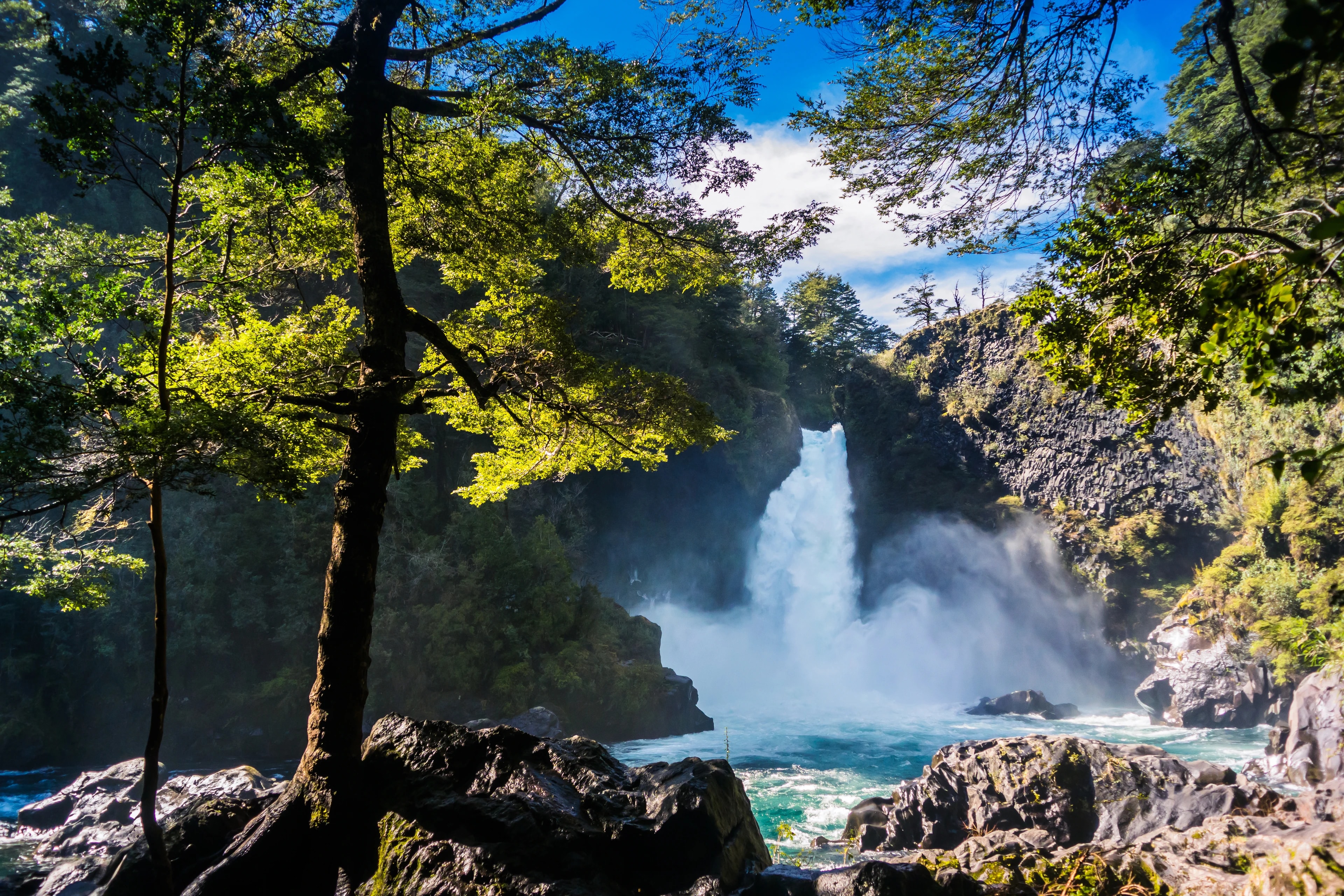
Deep in the Andes east of Panguipulli, the Huilo-Huilo Biological Reserve protects 100,000 hectares of pristine Valdivian temperate rainforest, one of the last intact tracts of this globally endangered ecosystem. The reserve is a world of moss-draped coigüe trees, waterfalls cascading through fern-covered gorges, and the silent presence of ancient alerce trees (Patagonian cypress) that can live for over 3,600 years.
Wildlife includes the endangered huemul deer, the tiny monito del monte (a marsupial relic of Gondwana), and the pudu, the world's smallest deer. The reserve has pioneered a model of sustainable tourism, with accommodation ranging from the fantastical Montaña Mágica Lodge (a waterfall cascading over its roof) to the Nothofagus Hotel built into a tree-covered hillside.
Activities include canopy walks, hiking to the Huilo-Huilo waterfall, night treks to spot wildlife, and visits to the reserve's huemul breeding programme that is slowly bringing this critically endangered species back from the brink.
Lakes and Rivers, A Waterscape Paradise
Los Ríos is defined by its waterways. The Calle-Calle, Cruces, San Pedro, and Bueno rivers form a navigable network that was the region's highway system long before roads arrived, and today they offer kayaking, canoeing, and boat excursions through some of southern Chile's most beautiful scenery. The Santuario de la Naturaleza del Río Cruces, a wetland created inadvertently when the 1960 earthquake (the most powerful ever recorded) caused the land to subside, is now a vast sanctuary for black-necked swans, coots, and dozens of other waterbird species, best explored by boat from the village of Punucapa, which also produces traditional chicha de manzana (apple cider).
The lakes of the Andean foothills, Panguipulli, Calafquén, Riñihue, and Pirihueico, are quieter and less developed than their famous neighbours in the Lake Region further north, offering swimming, fishing, and lakeside camping in settings of remarkable tranquillity.
Mapuche-Huilliche Heritage and Forest Cuisine
The Los Ríos region is home to the Huilliche branch of the Mapuche people, whose presence predates European contact by millennia. Huilliche communities in the coastal range and around the lake towns maintain traditions of herbal medicine, wooden boat-building, and ceremonial practices connected to the forest and the rivers. Their cuisine, increasingly recognised by Chilean chefs, draws on ingredients from the temperate rainforest: wild mushrooms (changle, digüeñe, and loyo), nalca (Chilean giant rhubarb), murta berries, and smoked meats prepared in traditional smoking huts.
The region's food scene is blossoming, with Valdivia restaurants and rural lodges offering menus that celebrate these forest ingredients alongside the exceptional local seafood, particularly the cholgas (mussels), oysters farmed in the river estuaries, and the region's famous smoked salmon.
The annual Valdivian Night festival in February fills the river with illuminated boats, fireworks, and music, drawing visitors from across Chile.
Points of Interest
Cities
Cities
Valdivia
Capital of the Los Ríos Region (population around 165,000), founded by Pedro de Valdivia in 1552 at the confluence of the Calle-Calle, Valdivia and Cau-Cau rivers. The city is shaped by 19th-century German immigration, its riverfront, its Kunstmann brewery and the iconic Mercado Fluvial (where sea lions sun themselves on the docks) all carry that imprint. The 1960 Valdivia earthquake, the largest ever measured at magnitude 9.5, was centred here. The Universidad Austral campus, the Castillo de Niebla fort and a string of river ferries to it complete the picture of one of southern Chile's most distinctive cities.
Cities
Panguipulli
Lakeside town of around 17,000 at the western end of Lago Panguipulli, in the Los Ríos Region. Locally known as the 'City of Roses' for the floral festival held every February, Panguipulli is the natural gateway to the Siete Lagos circuit and to the Andean parks around the Mocho-Choshuenco volcano. The distinctive wooden Iglesia San Sebastián, built in 1947 by German Capuchin missionaries with brightly painted facades, anchors the main square.
Cities
Coñaripe
Small town of around 3,000 on the southern shore of Lago Calafquén, in the Los Ríos Region. Coñaripe sits within striking distance of half a dozen of Chile's best-known hot springs, Termas Geométricas, Termas Coñaripe, Termas Vergara, and serves as the southern gateway to the Siete Lagos route. The Volcán Villarrica looms above the village, with the cone often visible from the lakeshore.
Scenic Spots
Scenic Spots
Lago Panguipulli
The 'Lake of Roses' in the heart of Chile's Lake Region, surrounded by lush temperate rainforest and overlooked by the Mocho-Choshuenco volcano. Gateway to the Siete Lagos route.
Scenic Spots
Lago Riñihue
Deep glacial lake famous for the 1960 'Riñihuazo', an epic effort to prevent catastrophic flooding after the Great Chilean Earthquake. Known for pristine waters and excellent fishing.
Scenic Spots
Lago Niltume
Small, secluded lake nestled between Panguipulli and Pirihueico in the Valdivian rainforest. A quiet retreat surrounded by ancient coigüe and lenga trees.
Scenic Spots
Lago Pirihueico
Narrow fjord-like glacial lake on the Argentine border, crossed by the Hua Hum ferry linking Chile and Argentina. Surrounded by dense Valdivian temperate rainforest.
Scenic Spots
Lago Ranco
One of Chile's largest lakes with a distinctive island-dotted interior, including Isla Huapi with its Mapuche community. Offers sailing, fishing, and uncrowded beaches.
Scenic Spots
Lago Maihue
Remote glacial lake east of Lago Ranco, accessible only by gravel road. A hidden gem with untouched native forest, superb trout fishing, and very few visitors.
Scenic Spots
Lago Huishue
Tiny, secluded lake in the Andes near the Argentine border, surrounded by dense native forest. One of the least-visited lakes in the Los Ríos region.
Scenic Spots
Lago Gris
Small mountain lake in the Valdivian Andes with grey-hued glacial waters. A remote destination reached by forest trails, offering complete wilderness solitude.
Scenic Spots
Lago Constancia
Hidden Andean lake in the Huilo-Huilo Biological Reserve, accessible via hiking trails through ancient temperate rainforest. Known for its mirror-still reflections.
Natural Reserves
Natural Reserves
Parque Nacional Alerce Costero
24,694-hectare national park (established 2012) on the coastal range west of Valdivia, sheltering ancient alerce trees over 3,500 years old. The boardwalk trail to El Alerce Milenario is the headline experience. Best visited November to April.
Dec–Mar 9:00–17:00 · Apr–Nov 9:00–16:00 · $4,000 CLP
Hiking · Wildlife · Viewpoint
Natural Reserves
Reserva Nacional Carlos Anwandter
4,877-hectare Ramsar wetland on the Río Cruces north of Valdivia, formed when the 1960 earthquake permanently sank the land. Home to black-necked swans, coscoroba swans, and herons. Open year-round.
Open all year · Free
Wildlife · Viewpoint
Natural Reserves
Reserva Biológica Huilo Huilo
100,000-hectare private reserve in the Andes near Volcán Choshuenco, founded in 1999. Famous for huemul and jaguar reintroduction programs, waterfalls, and themed eco-lodges. Open year-round.
Open all year · From $25,000 CLP
Hiking · Wildlife · Viewpoint · Lodging · Restaurant
Natural Reserves
Reserva Nacional Mocho-Choshuenco
7,536-hectare CONAF reserve (established 1994) covering the twin Mocho and Choshuenco volcanoes and the Mocho glacier. Hosts a small ski operation in winter. Best December to April.
Dec–Mar 8:30–18:00 · Apr–Nov 8:30–17:30 · $4,000 CLP
Hiking · Viewpoint · Ski
Natural Reserves
Parque Futangue
13,500-hectare private park on the southern shore of Lago Ranco, with over 70 km of trails, hanging bridges, lakes, and waterfalls. Open year-round.
Open all year · From $20,000 CLP
Hiking · Wildlife · Viewpoint · Lodging
Natural Reserves
Parque Oncol
754-hectare private park on Cerro Oncol (715 m) just north of Valdivia, opened in 1989. Showcases Valdivian temperate rainforest, with a canopy zipline and panoramic ocean views. Best October to April.
Daily 9:00–18:00 · $7,000 CLP
Hiking · Viewpoint · Picnic area · Camping
Natural Reserves
Reserva Costera Valdiviana
50,530-hectare coastal reserve managed by The Nature Conservancy since 2003, between Chaihuín and Corral. Protects the largest stand of coastal alerce and a long stretch of undeveloped Pacific shoreline. Open year-round.
Open all year · Free
Hiking · Wildlife
Natural Reserves
Termas Geométricas
Architecturally striking hot springs with 17 slate-lined pools connected by red boardwalks through a narrow forest ravine.
Daily 11:00–22:00 · $32,000 CLP
Thermal baths · Restaurant · Parking
Natural Reserves
Termas de Coñaripe
Established thermal resort near Coñaripe village with indoor and outdoor pools, a small hotel, and a riverside setting. Open year-round.
Daily 9:00–22:00 · $25,000 CLP
Thermal baths · Lodging · Restaurant · Parking
Natural Reserves
Termas Huilo Huilo
Boutique thermal pools inside the Huilo Huilo reserve, set in native forest and bundled with stays at the reserve's themed lodges.
Daily (for guests) · Included in stays
Thermal baths · Lodging · Restaurant
Natural Reserves
Termas de Manquecura
Small traditional bathhouse in the Liquiñe valley, with mineral-rich outdoor pools and a family-run atmosphere.
Daily 9:00–22:00 · $15,000 CLP
Thermal baths · Parking
Natural Reserves
Termas de Pellaifa
Modest thermal complex on the shore of Lago Pellaifa, with outdoor pools and a small lakeside lodge.
Daily 9:00–22:00 · $15,000 CLP
Thermal baths · Lodging · Parking
Natural Reserves
Termas de Quilalelfu
Family-run thermal baths in the Liquiñe valley with a covered pool and several rustic outdoor tubs.
Daily 9:00–22:00 · $15,000 CLP
Thermal baths · Parking
Natural Reserves
Termas Río Hueico
Rustic riverside baths off the Liquiñe road, a quiet alternative to the larger resorts in the valley.
Daily 9:00–22:00 · $10,000 CLP
Thermal baths · Parking
Natural Reserves
Termas Río Liquiñe
Long-running thermal complex in Liquiñe village itself, the anchor of the local hot springs cluster, with outdoor pools and a basic hotel.
Daily 9:00–22:00 · $15,000 CLP
Thermal baths · Lodging · Restaurant · Parking
Natural Reserves
Termas Trafipán
Small valley spa in the Liquiñe area with rustic pools fed by natural hot springs.
Daily 9:00–22:00 · $12,000 CLP
Thermal baths · Parking
Breweries
Breweries
Compañía Cervecera Kunstmann
The flagship of Chilean craft beer, founded by a German-descended family in Valdivia and now offering a full visitor center with brewery tours, a beer museum, the on-site restaurant La Cervecería, and guided tastings of experimental and limited-edition beers.
Daily 12:00–23:00
Beer tasting · Tours · Restaurant · Shop · Visitor center · Parking
Breweries
El Growler
Microbrewery and brewpub on Isla Teja in Valdivia, founded as a joint Chilean-American project to anchor the city's growing craft beer culture.
Tue–Sat 18:00–01:00
Beer tasting · Restaurant
Breweries
Cervecería Cuello Negro
Well-known Valdivian craft brand with a small taproom in town, named after the black-necked swans of the Río Cruces wetlands.
Tue–Sun 18:00–01:00
Beer tasting · Restaurant · Shop