ExploreChileliving unforgettable adventures


Coquimbo
Straddling the transition between desert and fertile central Chile, the Coquimbo Region offers an extraordinary mix of astronomy, beaches, and wine country. La Serena, one of Chile's oldest cities, charms visitors with colonial churches, a long sandy coastline, and the nearby Elqui Valley, birthplace of Nobel laureate Gabriela Mistral and Chile's pisco distilleries.
Audio version available
La Serena and Coquimbo, Twin Cities on the Coast
La Serena, founded in 1544 as Chile's second city, retains a gracious colonial air with its stone churches, tree-lined plazas, and the distinctive neocolonial architecture imposed by President González Videla in the 1950s, which gives the city centre a unified, almost Mediterranean elegance. Its Avenida del Mar stretches for kilometres along a broad sandy beach popular with families, surfers, and kite-flyers.
Across the bay, the port city of Coquimbo is grittier and more working-class, crowned by the massive Cruz del Tercer Milenio cross that offers panoramic views from its observation deck.
The Barrio Inglés in Coquimbo's old quarter preserves timber houses from the British-influenced mining era, and the waterfront market serves the region's famous seafood, particularly paila marina, a rich shellfish broth, and machas a la parmesana, razor clams gratinéed with Parmesan cheese.
The Elqui Valley, Pisco, Poetry, and Stars
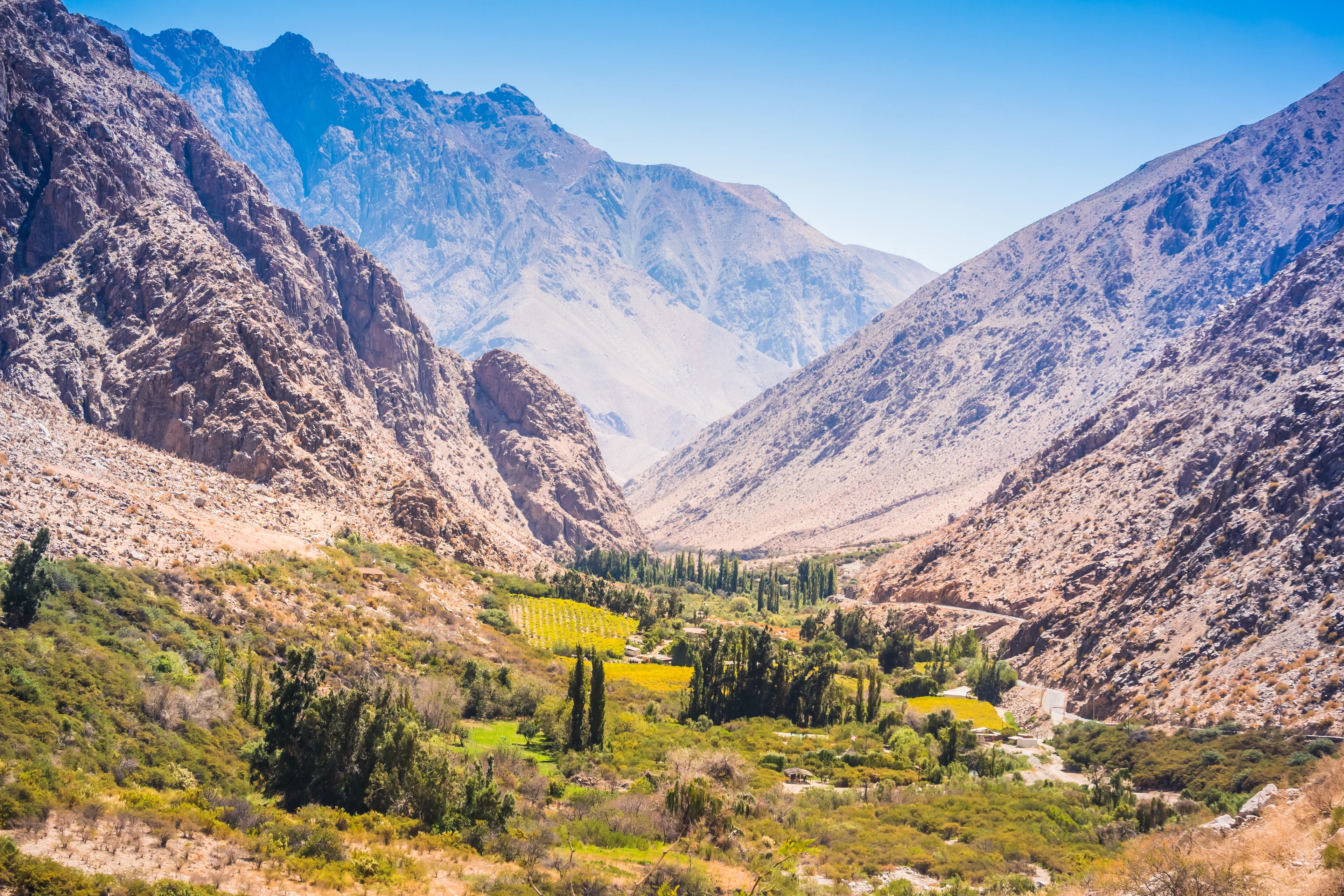
Winding east from La Serena into the Andean foothills, the Elqui Valley is a narrow green ribbon of vineyards, papaya orchards, and small villages squeezed between arid mountainsides that glow copper and gold in the afternoon light. This is the birthplace of pisco, Chile's national spirit, and dozens of distilleries from artisan family operations to major producers like Capel and Mistral offer tastings and tours.
The valley is also the homeland of Gabriela Mistral, the poet and educator who in 1945 became the first Latin American to win the Nobel Prize in Literature; her childhood home in Montegrande is now a museum, and her lyrical descriptions of the Elqui landscape remain touchstones of Chilean identity.
By night, the valley transforms: with some of the clearest skies on the planet, it hosts professional observatories like Cerro Tololo and La Silla alongside tourist-friendly telescope centres where guides trace constellations visible only from the Southern Hemisphere.
Marine Reserves and Coastal Wilderness
Off the coast of the Coquimbo Region, the cold nutrient-rich Humboldt Current creates one of the Pacific's most productive marine ecosystems. The Humboldt Penguin National Reserve, spanning the islands of Choros, Damas, and Chañaral de Aceituno, protects breeding colonies of Humboldt penguins alongside sea lions, marine otters, and pods of bottlenose dolphins that regularly approach the small boats ferrying visitors between the islands.
In good years, migrating blue whales and fin whales pass through these waters, making it one of the few accessible places in Chile to spot the largest animals on Earth.
On land, the Fray Jorge National Park preserves a patch of Valdivian cloud forest, lush ferns, mosses, and trees that have no business existing this far north, surviving entirely on moisture from the coastal fog, a living relic of a time when Chile's climate was wetter.
Wine, Craft Beer, and Farm-to-Table Cuisine
The Coquimbo Region's wine country is centred on the Limarí Valley, where cool coastal fog and limestone-rich soils produce elegant Chardonnays, Syrahs, and Pinot Noirs that have earned international recognition and challenged the dominance of Chile's traditional wine heartland further south. Wineries like Tabalí, Casa Tamaya, and Viña Maycas del Limarí offer tastings in settings that range from modern gravity-fed cellars to rustic adobe farmhouses.
The region has also become a hub for craft pisco cocktails and small-batch distilling, with mixologists in La Serena and Vicuña reinventing the classic pisco sour with local botanicals and fruit syrups.
Farm-to-table dining is emerging in the valleys, where chefs work with papayas, cherimoyas, goat cheese, and honey harvested from the arid hillsides to create a cuisine that is distinctly Coquimbano.
Petroglyphs, Archaeology, and Desert Trails
The Coquimbo Region's river valleys are dotted with archaeological sites that reveal thousands of years of human habitation. The Valle del Encanto, a narrow canyon near Ovalle, contains over 30 petroglyph panels and carved stone mortars left by the Molle and Diaguita cultures, set amid house-sized boulders that create a natural amphitheatre.
The Museo del Limarí in Ovalle displays one of Chile's finest collections of Diaguita ceramics, the geometrically painted bowls and urns that are considered masterpieces of pre-Columbian art. For hikers, the Andes east of the Elqui Valley offer multi-day treks through valleys painted in mineral colours, ochre, green, violet, with wild guanacos for company and campsites beside crystal-clear streams.
The Paso del Agua Negra, which crosses to Argentina at over 4,700 metres, is one of the most scenic and hair-raising mountain passes in the Americas.
Points of Interest
Cities
Cities
La Serena
Chile's second-oldest city (founded 1544, population around 220,000) and the historic capital of the Coquimbo Region. La Serena is defined by the neocolonial facades imposed by President Gabriel González Videla in the 1950s, which give the centre a unified Andalusian character, and by the four-kilometre Avenida del Mar beachfront that fills up every January with holidaymakers from Santiago and Argentina. The Iglesia de San Francisco, the Recova market and the archaeological museum with its Diaguita ceramics anchor the historic core; the Elqui Valley starts at the eastern edge of town.
Cities
Coquimbo
Working port city of about 230,000 that shares a bay with La Serena and forms Chile's largest coastal conurbation north of Valparaíso. Coquimbo is crowned by the 93-metre Cruz del Tercer Milenio, built for the year 2000, and by the Barrio Inglés, a cluster of 19th-century timber buildings from the British-influenced mining era, now full of restaurants and bars. The Guayacán peninsula shelters the fishing caleta where paila marina and machas a la parmesana are served straight off the boats, and the Terminal Pesquero market moves the bulk of the region's shellfish.
Cities
Ovalle
Agricultural hub of around 100,000 in the Limarí Valley, roughly 90 km south of La Serena, and the gateway to some of the Coquimbo Region's most striking landscapes. Ovalle is surrounded by pisco distilleries, papaya and cherimoya orchards, and vineyards producing the cool-climate Chardonnays and Syrahs that have put Limarí on the wine map. The nearby Valle del Encanto contains one of Chile's densest concentrations of pre-Columbian petroglyphs, and the Museo del Limarí holds a benchmark collection of Diaguita pottery; further south, the Fray Jorge cloud-forest national park is an easy day trip.
Cities
Vicuña
Small Elqui Valley town of around 25,000, 60 km east of La Serena, best known as the birthplace of poet and Nobel laureate Gabriela Mistral and as Chile's astro-tourism capital. Vicuña sits at 730 metres surrounded by pisco vineyards, papaya groves, and the copper-and-ochre Andean foothills; the Museo Gabriela Mistral and the Torre Bauer clock tower anchor the plaza. The town is the launching point for the Mamalluca, Pangue and Alfa Aldea observatories, and the surrounding valley hosts many of the artisan and industrial pisco distilleries that define Chilean spirits.
Observatories
Observatories
Observatorio Cerro Mamalluca
Opened in 1998 by the Municipality of Vicuña, Mamalluca was the first observatory in Chile purpose-built for astro-tourism and remains the country's most-visited. Its 30 cm Meade telescope drives nightly programmes covering Andean cosmology, the Rapa Nui and Mapuche sky, and deep-sky observation. Reservations are essential; the drive up Cerro Mamalluca (nine km east of Vicuña) is worth doing before sunset for the valley views.
Daily 18:30–00:00
Observatories
Observatorio del Pangue
Small semi-professional observatory 17 km south of Vicuña, run by French-Chilean astronomers and specialising in serious deep-sky observation. Its 63 cm Dobsonian telescope is among the largest available to the public in Chile, and small-group sessions (max 8 people) are the norm, booked days in advance and tailored to what is rising that night.
By reservation
Observatories
Observatorio Andino Chakana
Boutique astro-tourism venue in the Alcohuaz sub-valley south-east of Vicuña, where the sky darkens noticeably as you leave the main Elqui road. Chakana runs guided tours of the southern sky with mid-sized telescopes, and a limited nightly capacity makes it one of the more contemplative Elqui experiences.
By reservation
Observatories
Centro Astronómico Alfa Aldea
Astronomical experience venue on the edge of Vicuña that combines a laser-guided tour of the southern sky, telescope observation and a full Elqui-style dinner (pisco flight, wine, regional dishes) under a large open-air stone amphitheatre. The programme is designed for visitors who want astronomy alongside food and place, rather than a pure telescope session.
Daily 20:00–23:00
Observatories
Observatorio Collowara
Municipal tourist observatory on Cerro Churqui above Andacollo, 55 km inland from Coquimbo. A 14-inch Meade telescope and a bank of smaller instruments serve nightly public sessions, and the site's altitude of about 1,300 m keeps it clear when the coastal fog rolls into La Serena.
Daily 20:30–23:30
Observatories
Observatorio Interamericano Cerro Tololo
Founded in 1965 by AURA and operated today by NSF's NOIRLab, Cerro Tololo is one of the flagship professional observatories of the southern hemisphere. The site houses the 4-metre Víctor M. Blanco Telescope (host of the Dark Energy Camera / DECam) and the SMARTS array; its summit lies 60 km east of La Serena at 2,200 m altitude. Public tours run Saturday mornings only, by prior application to the CTIO office in La Serena.
Saturday tours only
Observatories
Observatorio La Silla
The first observatory of the European Southern Observatory (ESO), opened in 1969 on a 2,400 m ridge 155 km north-north-east of La Serena. La Silla hosts around 18 telescopes, including the 3.58 m New Technology Telescope (NTT) and the 3.6 m ESO Telescope with the HARPS spectrograph responsible for a large share of the world's exoplanet discoveries. Free public visits run one Saturday a month, by advance application to ESO Chile.
First Saturday of month
Pisco Distilleries
Pisco Distilleries
Pisco Capel
Cooperativa Agrícola Pisquera Elqui (Capel), founded in 1938 by producers of the Elqui and Limarí valleys, is Chile's largest pisco company. The main plant sits just outside Vicuña on Camino Peralillo, where the Centro Turístico Capel opens to the public year-round with distillery tours, a small pisco-heritage museum and tastings across the ranges, from the young Capel through the aged Alto del Carmen and Espíritu de los Andes.
Daily 10:00–18:00
Tours · Shop · Tasting
Pisco Distilleries
Pisquera ABA
Artisan distillery on a family estate operating since 1921 at Km 66 of Ruta 41 in Vicuña, in the heart of the Elqui Valley. ABA produces small-batch piscos from 35° to 40°, from the flagship ABA through the aged ABA Envejecido, Fuegos Reservado and the lighter Círculo del Elqui, alongside ready-to-drink pisco sours in maqui, mango, pomelo, lemon and pomegranate. Tours run Mon–Wed 10:00–17:00 and Thu–Sun 10:00–18:00.
Tours · Shop · Tasting
Pisco Distilleries
Pisco Doña Josefa de Elqui
Family-run premium pisquera in the Elqui Valley, built around a small tourist complex that also includes an on-site restaurant and guest cabañas. The distillery focuses on hand-crafted piscos from local muscat grapes; tours, tastings and shop visits are available year-round through the reception.
Tours · Shop · Tasting · Lodging · Restaurant
Pisco Distilleries
Fundo Los Nichos
The oldest artisan pisco distillery in Chile, founded in 1868 by Rigoberto Rodríguez in the tiny village of Los Nichos, a few kilometres south of Pisco Elqui. The estate is best known for its cellars dug into the hillside and still lined with the wine-filled niches that gave the place its name, and for its traditional double-distilled pisco produced from muscat and pedro jiménez grapes.
Tours · Shop · Tasting
Wineries
Wineries
Cavas del Valle
Small boutique estate at km 21 of the road from Vicuña to Pisco Elqui, known both for its handcrafted piscos and for a much-loved sweet muscat wine (Mostacilla) made in the traditional Elqui style. Tastings take place in a rustic stone-and-adobe cellar; the road up-valley from here is one of the most scenic stretches of the whole Elqui.
Wine Tasting · Tours · Shop
Natural Reserves
Natural Reserves
Chañaral de Aceituno
Small fishing village on the far northern coast of the Coquimbo Region, about 80 km north of La Serena and reached by a rough gravel spur off Route 5. Its caleta is the closest departure point for boats to Isla Chañaral, the largest island of the Humboldt Penguin National Reserve, and between December and April the same boats regularly encounter blue whales, fin whales and pods of bottlenose dolphins in the nutrient-rich waters of the Humboldt Current.
Open all year
Wildlife · Boat tours
Natural Reserves
Punta de Choros
Coastal hamlet 115 km north of La Serena, at the end of a long dirt road through the Atacama scrub, and the main jumping-off point for the Humboldt Penguin National Reserve. Boats depart daily for the islands of Choros and Damas, where visitors can see Humboldt and Magellanic penguins, sea lions, sea otters and, in season, whales and dolphins at close range. The village itself is a handful of fisher-family lodgings, a couple of restaurants serving scallop empanadas and paila marina, and a beach of extraordinarily clear turquoise water.
Open all year
Wildlife · Boat tours
Natural Reserves
Reserva Nacional Pingüino de Humboldt
Marine reserve spanning the islands of Choros, Damas and Chañaral, home to roughly 80 % of the world's Humboldt penguin population alongside colonies of sea lions, marine otters (chungungos), guanay cormorants and Peruvian boobies. Access is by boat from Punta de Choros or Chañaral de Aceituno; landings are allowed only on Isla Damas, with tight daily visitor quotas to protect the wildlife. In the austral summer the surrounding waters are one of the most reliable places in Chile to spot blue whales and fin whales.
Daily 9:00–17:00 · CLP 5,000
Wildlife · Boat tours
Natural Reserves
Guanaqueros
Resort village of a few thousand permanent residents around a sheltered horseshoe bay 40 km south of Coquimbo. Guanaqueros grew as a fishing caleta and still lands scallops and seaweed for the wider market, but its calm, warm-water beach and the string of low-rise seafood restaurants along the arc have turned it into a low-key summer destination for families from La Serena and Santiago.
Open all year
beach · Restaurant
Natural Reserves
Totoralillo
Compact turquoise-water beach 15 km south of Coquimbo, tucked into a small bay flanked by rocky headlands. Totoralillo is the region's best-known surf and body-boarding beach, with reliable waves at the north point and a laid-back backpacker scene of campgrounds, food trucks and a couple of surf schools that dominates the coastline through summer.
Open all year
beach · surfing
Natural Reserves
Tongoy
Beach town of around 10,000 residents on a wide sandy peninsula 55 km south of Coquimbo, best known for its scallop industry and its two long, calm beaches (Playa Grande and Playa Socos). The seafood restaurants along the waterfront serve the scallops fresh, often grilled with Parmesan (ostiones a la parmesana), and the surrounding bay is a nursery ground for Humboldt penguins occasionally seen from the coast.
Open all year
beach · Restaurant
Natural Reserves
Parque Nacional Bosque Fray Jorge
UNESCO Biosphere Reserve 110 km south of La Serena, protecting a startling relic of Valdivian cloud forest surviving 1,000 km north of its natural range. The ferns, mosses, olivillos and canelos at the ridge tops (around 550 m) survive entirely on the moisture wrung from the coastal camanchaca fog, so the forest is often invisible from the road and then suddenly emerges as you climb into the mist. A boardwalk loop leads through the densest patches; below, the arid coastal steppe is home to guanacos, culpeo foxes and endemic cactus.
Daily 9:00–17:00 · CLP 5,000
Hiking · Wildlife
Natural Reserves
Monumento Natural Pichasca
Small natural monument in the Río Hurtado valley 45 km north-east of Ovalle, protecting a rare petrified araucaria forest from the Cretaceous alongside a large sandstone shelter used by Molle and Diaguita peoples that still holds red-and-black rock paintings. A short loop trail passes both the fossilised trunks and the alero paintings, and the surrounding valley is one of the least-touristed and most photogenic corners of the Coquimbo interior.
Daily 9:00–17:00 · CLP 3,000
Hiking · Wildlife
Natural Reserves
Reserva Nacional Las Chinchillas
Reserve 15 km north-east of Illapel established in 1983 to protect the last wild populations of the long-tailed chinchilla, driven to the edge of extinction by the fur trade in the early 20th century. The animals are nocturnal and rarely seen without a guide, but the reserve's interpretation centre, dawn-and-dusk guided walks and the arid-matorral landscape of cardones and boldos make it one of the most rewarding wildlife stops in the region for visitors willing to slow down.
Daily 9:00–17:00 · CLP 4,000
Wildlife · Hiking
Natural Reserves
Valle del Elqui
Narrow, luminous river valley climbing east from La Serena into the Andes, famous in equal measure for pisco distilling, professional and tourist astronomy, and its layered esoteric-spiritual community. The valley strings together a series of small villages, Vicuña, Paihuano, Pisco Elqui, Alcohuaz, each with its own vineyards, artisan producers and observatories; nights routinely deliver some of the darkest, clearest skies in the world, and the mineral-coloured hills glow copper and gold in the low afternoon light.
Open all year
Wine Tasting · Stargazing · Hiking