ExploreChileliving unforgettable adventures


Biobío
The Biobío Region is one of Chile's economic powerhouses, where the mighty Biobío River, the country's second longest, flows from Andean lakes to the Pacific. Concepción, the capital, is a university city with a thriving arts scene, rebuilt with resilient spirit after the devastating 2010 earthquake.
Audio version available
Concepción, University City and Cultural Hub
Concepción, Chile's second-largest metropolitan area, pulses with a youthful energy driven by the Universidad de Concepción, one of South America's most prestigious universities, whose sprawling campus is a city unto itself with its own iconic murals, botanical gardens, and concert hall. The city has been destroyed and rebuilt multiple times by earthquakes and tsunamis, most recently in 2010, and this cycle of destruction and renewal has forged a resilient, forward-looking character.
The Barrio Universitario buzzes with live music venues, craft-beer bars, and independent bookshops, while the Casa del Arte houses a monumental mural by Jorge González Camarena depicting Latin American history.
The Biobío River, Chile's only navigable river of consequence, sweeps past the city on its way to the sea, crossed by bridges that light up at night and connect Concepción to its twin city of San Pedro de la Paz. The surrounding wetlands, the Humedales de Concepción, provide critical habitat for over 100 bird species within city limits.
The Laja Falls and Laguna del Laja
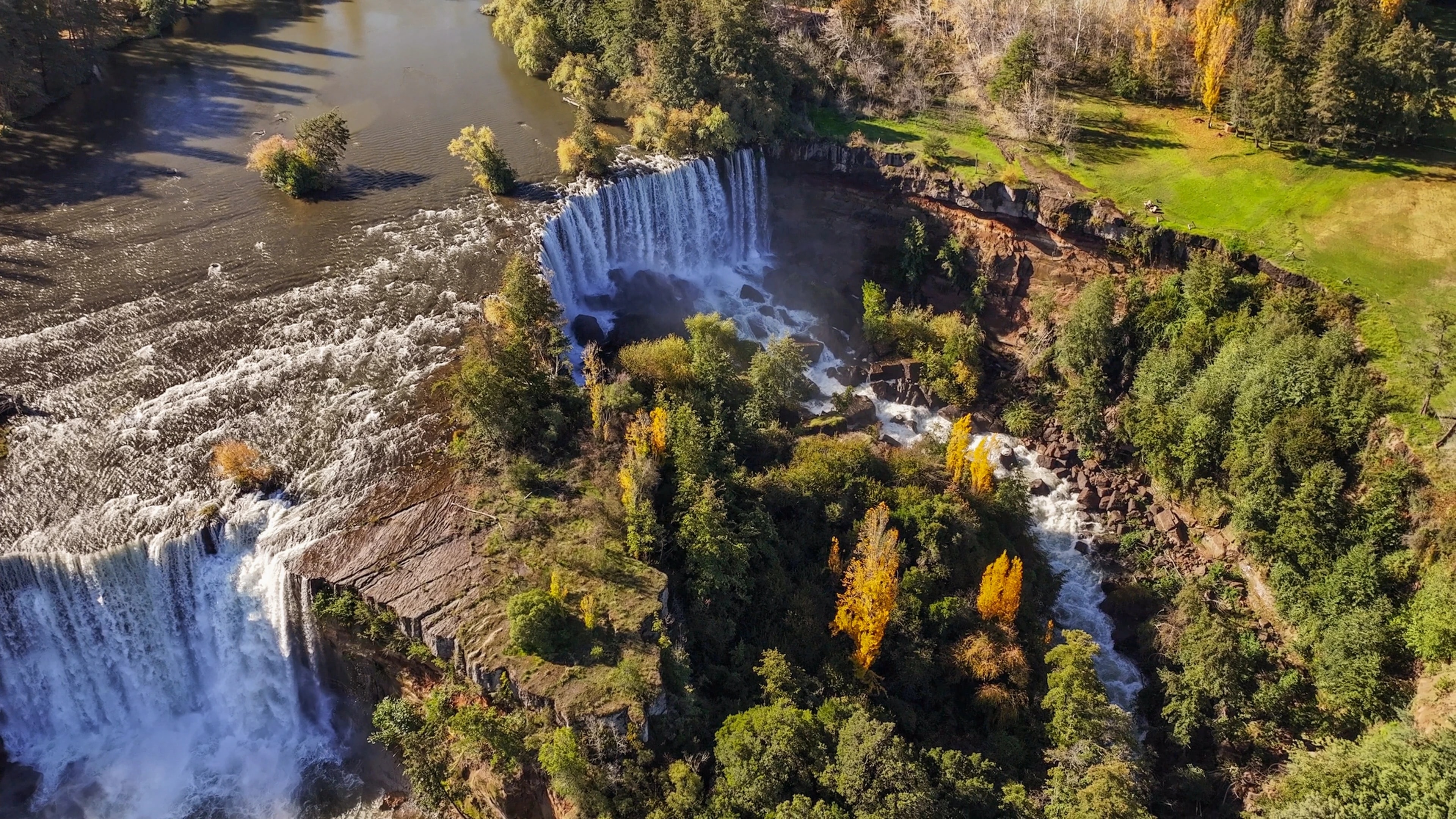
The Salto del Laja is one of Chile's most recognisable natural landmarks: a 35-metre horseshoe waterfall where the Laja River plunges over a cliff of columnar basalt into a misty gorge, visible from the Pan-American Highway. The falls are at their most impressive in spring when snowmelt swells the river, and a series of viewpoints and walkways allow visitors to feel the spray on their faces.
Upstream, the Laguna del Laja National Park wraps around the Antuco volcano (2,979 m) and its glacier-fed lake, offering hiking trails through lava fields, native forest, and alpine meadows dotted with wildflowers.
The Sierra Velluda range, visible from the lake's shore, presents a jagged wall of snow-capped peaks that is one of the most dramatic mountain vistas in central Chile. In winter, the Centro de Ski Antuco offers affordable family skiing with views over the frozen lake.
Coal Coast and Maritime Heritage
The Biobío coast has a rich industrial and maritime heritage that sets it apart from the agricultural regions further north. Lota, once Chile's coal-mining capital, preserves the Parque de Lota, an English-style garden commissioned by the Cousiño mining dynasty, and offers underground tours of the abandoned coal mines that powered Chile's industrialisation in the 19th century.
The historic port of Talcahuano, Chile's main naval base, shelters the Huáscar, a Peruvian ironclad captured during the War of the Pacific in 1879 that is now a floating museum and one of the world's oldest surviving warships of its type. The fishing village of Dichato, devastated by the 2010 tsunami and painstakingly rebuilt, has become a symbol of coastal resilience and now attracts visitors with fresh seafood restaurants and calm swimming beaches.
Tomé, known for its textile industry and crescent beach, rounds out a coastline where industry, history, and natural beauty interweave.
The Biobío Canyon and Mapuche Country
The upper Biobío River carves a dramatic canyon through the Andes that was once considered one of the world's premier white-water rafting destinations, Class IV and V rapids surging through a gorge of temperate rainforest. Although hydroelectric dams have tamed much of the river, the canyon remains hauntingly beautiful, and sections upstream of the reservoirs still offer rafting and kayaking.
This is also the heartland of the Pehuenche people, a branch of the Mapuche nation whose name means 'people of the pehuén', the Araucaria tree whose protein-rich pine nuts (piñones) have sustained them for millennia.
Pehuenche communities in villages like Ralco and Quepuca Ralco maintain traditional ruka (thatched roundhouses), weaving practices, and ceremonial gatherings, and some offer cultural tourism experiences that provide genuine insight into a way of life that predates European contact by thousands of years.
Forests, Wetlands, and Emerging Eco-Tourism
The Biobío Region's ecological diversity is often overlooked in favour of the more famous parks further south, but it harbours some of Chile's most important temperate forest and wetland ecosystems. The Reserva Nacional Nonguén, on the outskirts of Concepción, protects a remnant of the coastal Valdivian rainforest, dense stands of olivillo, lingue, and canelo draped in mosses and ferns, and is one of the few places where the critically endangered Darwin's fox has been spotted outside of Chiloé.
The Humedal Rocuant-Andalién, a coastal wetland at the mouth of the Andalién River, hosts flamingos, black-necked swans, and dozens of migratory species.
Inland, the emerging eco-tourism corridor along the Biobío and Laja rivers offers horseback riding, fly-fishing for rainbow and brown trout, and multi-day treks through native forest, positioning the region as an accessible alternative to Patagonia for nature-seeking travellers based in Santiago.
Points of Interest
Cities
Cities
Concepción
Capital of the Biobío Region (population around 225,000; metropolitan area close to one million) and Chile's second city. Founded by Pedro de Valdivia in 1550, it moved to its current spot in 1764 after a tsunami flattened the original site at Penco. The Universidad de Concepción (1919), its leafy campus crowned by the iconic Mural Histórico by Gregorio de la Fuente, gives the city a strong student energy, and its rock scene (Los Tres, Los Bunkers, Los Tetas) put it on the country's cultural map. Concepción is also the city that has rebuilt itself after almost every great Chilean earthquake, 1939, 1960, 2010.
Cities
Los Ángeles
Agricultural and forestry hub of around 205,000 in the Biobío Region, founded as a fort in 1739. Los Ángeles is the practical gateway to the Salto del Laja waterfalls just north of town and to Parque Nacional Laguna del Laja in the Andes, with the Antuco volcano rising behind. The surrounding countryside, pine and eucalyptus plantations, dairy fields, river valleys, is one of the engines of Chile's forestry industry.
Cities
Talcahuano
Port city of around 165,000 on the peninsula opposite Concepción, home of the Chilean Navy's main Pacific base. Its biggest draw is the Monitor Huáscar, the Peruvian ironclad captured at the 1879 Battle of Angamos, now moored as a museum ship. The city's working fish markets, the Tumbes coastal lookout and a long Pacific waterfront round out the visit. Talcahuano's downtown was hit hard by the 2010 tsunami and has been rebuilt with new seawalls.
Natural Reserves
Natural Reserves
Parque Nacional Laguna del Laja
CONAF national park of 11,600 hectares created in 1958, anchored by Volcán Antuco (2,979 m) and the lava-dammed Laguna del Laja. Coigüe and ñirre forest, Andean condors and a handful of high-altitude waterfalls including the Salto Las Chilcas. Open year-round, with the volcano summit and the lake's far shore most accessible Dec–Mar.
Dec–Mar 8:30–18:00 · Apr–Nov 8:30–17:30 · $5,000 CLP
Hiking · Camping · Wildlife · Viewpoint · Picnic area
Natural Reserves
Isla Mocha
CONAF national reserve of 2,367 hectares (created 1988) on a remote Pacific island 35 km off Tirúa. One of only three nesting colonies of the pink-footed shearwater in the world, and a place sacred to the Lafkenche; the white sperm whale 'Mocha Dick' sighted in these waters in the 1830s is widely credited with inspiring Melville's Moby Dick. Reached by small plane or boat.
Open all year · $5,000 CLP
Hiking · Wildlife · Camping · Viewpoint
Natural Reserves
Parque Nacional Nonguén
Chile's newest national park (created 2021 from the former reserve), protecting 3,037 hectares of Valdivian coastal rainforest on the eastern edge of the Concepción metropolitan area. The roble, coigüe and olivillo forest is one of the last large remnants of this ecosystem at low elevation, with marked trails and a CONAF visitor centre.
Daily 8:30–17:30 · $5,000 CLP
Hiking · Wildlife · Picnic area · Visitor center
Natural Reserves
Reserva Nacional Ralco
CONAF reserve of around 12,420 hectares in the Alto Biobío Andes, deep in pehuenche territory. Araucaria forest, glacial lakes and the upper Biobío watershed; access in summer only, with a small ranger station at Pitril. The reserve sits alongside the Ralco hydroelectric dam that drowned part of the original valley.
Dec–Mar 9:00–18:00 · $4,000 CLP
Hiking · Camping · Wildlife · Viewpoint
Natural Reserves
Altos de Pemehue
Remote 22,000-hectare CONAF reserve in the Andean cordillera, created in 2002 to protect the high catchment of the Bío Bío and Itata rivers. Mostly used for research and managed-access expeditions; visitors enter only with a permit from CONAF Biobío.
Restricted access · Free (permit required)
Hiking · Camping · Wildlife
Natural Reserves
Santuario de la Naturaleza Hualpén
Coastal sanctuary of 2,613 hectares on the Hualpén peninsula at the mouth of the Río Biobío, protecting native ruil and coigüe forest, sea cliffs and the Las Brujas cave. The eastern flank houses the Hualpén Park Museum and a string of caleta seafood restaurants below it.
Open all year · Free
Hiking · Wildlife · Viewpoint · Parking
Natural Reserves
Monumento Natural Contulmo
Tiny but historically important CONAF monument of just 82 hectares, established in 1941 — one of the oldest protected areas in Chile. Protects a relict patch of olivillo, lleuque and ulmo forest with a short interpretive trail; located on the road between Contulmo and Purén in the Cordillera de Nahuelbuta foothills.
Dec–Mar 9:00–18:00 · $3,000 CLP
Hiking · Wildlife · Picnic area
Natural Reserves
Parque Reussland
Privately owned native arboretum and conservation park in the inland Arauco province, created by the Reuss family on the model of southern Chilean montane forest. Marked trails through ruil, coigüe and ulmo stands; visitor numbers stay low and access is by appointment.
By appointment
Hiking · Camping · Wildlife
Natural Reserves
Parque Jorge Alessandri
Free educational forestry park of 26 hectares run by Mininco/CMPC on the southern outskirts of Concepción, opened in 1993. A native-species arboretum, a tree nursery, a small natural-history exhibition and a network of paths laid out around an artificial lake — popular as a family day-out from the city.
Daily 10:00–18:00 · Free
Hiking · Visitor center · Parking · Picnic area
Natural Reserves
Cerro Caracol
Urban hill park rising 250 m above central Concepción, with the Mirador Alemán and Mirador Chino looking out over the Biobío River and the campus of the Universidad de Concepción. Paved and dirt trails through a mix of native and exotic forest; the standard sunset walk for residents.
Open all year · Free
Hiking · Viewpoint
Natural Reserves
Playa Dichato
Crescent-shaped bay on the coast north of Concepción with the most popular family beach in the Biobío. The town was devastated by the 2010 tsunami and rebuilt along its old grid; the calm bay, the costanera and the seafood restaurants of Caleta Dichato remain the draw.
Open all year · Free
Swimming · Parking
Natural Reserves
Isla Santa María
Small Pacific island (~30 km² and around 2,500 inhabitants) in the Gulf of Arauco, reached by boat from Lota or Coronel. Cliff-top farmland, fishing villages, sea-lion rookeries and the historic Faro Santa María lighthouse — one of the most untouched corners of the Biobío coast.
Open all year · Free
Wildlife · Viewpoint
Natural Reserves
Caleta Tumbes
Working fishing cove on the Tumbes peninsula north of Talcahuano, with sea-lion-watched piers and a row of restaurants serving fresh marisco. The cliff-top road from here south to the navy base of Tumbes is a classic Concepción Sunday drive.
Open all year · Free
Viewpoint · Parking
Natural Reserves
Caleta Lenga
Traditional fishing village on the southern side of the Hualpén peninsula, just outside Concepción, famous in the region for its rustic seafood restaurants strung right above the high-tide line.
Open all year · Free
Swimming · Parking
Natural Reserves
Caleta Chome
Secluded fishing cove on the southern tip of the Hualpén peninsula, with a small lighthouse, cliff-foot beach and a single road in. Sea otters, cormorants and pelicans roost on the offshore rocks; the caleta is the end-point of the Bío Bío coastal trail.
Open all year · Free
Wildlife · Viewpoint · Parking
Natural Reserves
Playa Coliumo
Sheltered bay and fishing village in the commune of Tomé, with a long curve of clean sand and views back to the Cerro Coliumo peninsula. Calm waters suitable for swimming, popular with families from Concepción on summer weekends.
Open all year · Free
Swimming · Parking
Natural Reserves
Playa Ramuntcho
Hidden cove on the coast near Tomé, famous for its dramatic black-and-white rock outcrops and clear emerald water at low tide. Less developed than Dichato or Coliumo and best reached on foot from the main road.
Open all year · Free
Swimming · Viewpoint · Parking
Natural Reserves
Playa Blanca
Long Pacific beach south of Lota on the Arauco coast, with pale dunes, scattered fishing huts and reliable summer surf. Quiet outside the high season and a regular weekend stop for families from the Greater Concepción area.
Open all year · Free
Swimming · Parking
Natural Reserves
Playa Quidico
Remote left-hand point break and long sand beach in the southern Arauco province, deep in Mapuche–Lafkenche country. The village around it is small, the surf can be powerful, and the surrounding forested hills feel a world away from the Concepción coast.
Open all year · Free
Swimming · Parking
Natural Reserves
Alto Biobío
Remote Andean territory of the Pehuenche people, with pristine rivers, araucaria forests, and traditional communities.
Wineries
Wineries
Viña Quinta Rosa
Viña Quinta Rosa is a boutique family bodega in Yumbel, in the heart of the Valle del Biobío. The family thread stretches back to the early twentieth century, when grandfather Carlos Efraín worked País vines in the Quinquihueno and Los Mártires estates of Rere; from 1920 onwards the project settled into the Fundo Quinta Rosa in Yumbel, which still anchors the bodega today. For most of its history the estate sold its production as bulk wine. The turning point came in 2019, when Arturo Escobar, third generation, began bottling under the family's own label and built a proper wine tourism offer around it. The estate counts roughly forty hectares of patrimonial vineyards, some with parras over three hundred years old, making Quinta Rosa one of the truest custodians of the País grape in southern Chile. The portfolio centres on the País in three styles, dry, sweet, and rosé, drawn from those ancient vines. The work is artisanal and small-scale, in line with the wider revival of patrimonial wines in Biobío. The visitor programme is anchored by 'Tour Patrimonial Escapadas Ancestrales', a heritage walk through the vineyards combined with guided tastings, group lunches, and time among the old vines. Quinta Rosa was named Best Emerging Winery of the Biobío Region in 2023 and Best Wine Tourism Experience of the Biobío Region in 2024, twin awards that helped position the valley as Chile's next serious wine-travel destination. Visits are by appointment, coordinated by Magdalena Jara on +56 9 8189 7789.
Mon–Fri 10:00–18:00
Wine Tasting · Tours · Shop
Wineries
Viña San Roke
Viña San Roke is the family wine project of the Rozas in San Rosendo, Región del Biobío, at Los Callejones de Tur s/n. The family thread runs from Andrés Rozas, who inherited the vineyards in 1930 and began chasing the idea of making the family's own wine, to his son José Luis Rozas, who in 1980 started bottling under the small brand 'Caprily', sold in chuicas (demijohns) to local clients. The rebirth came after the 2010 earthquake, which forced a reset of the cellar. José Luis's sons Cristian and Felipe Rozas, the third generation, used the rebuild to redesign the project from the ground up, and in 2015 the first official bottlings under the new Sanroke label went out. In 2011, during that same period of rediscovery, the family confirmed that some of the vines on the estate were ancestral Malbec, locally known as 'Burdeo', planted around 1860 and now considered the oldest Malbec vines in South America. Those vines today anchor the bodega's identity. The wider portfolio includes Malbec from those ancestral parras, alongside Pinot Noir, Chardonnay, and Nebbiolo, which thrive on the cool, river-shaped terroir of the Biobío. The estate has grown into one of the cardinal stops of Biobío's emerging wine-tourism map. The offer combines tastings and guided cellar and vineyard tours with a wine shop, wine club subscriptions, a restaurant, on-site accommodation, and the 'Domo' venue for private and curated experiences.
Mon–Fri 10:00–18:00
Wine Tasting · Tours · Shop · Restaurant · Lodging
Wineries
Viña Santa Ángela
Viña Santa Ángela sits in the Lloicura sector of Tomé, a coastal-rural pocket of the Biobío Region, surrounded by native forest and gentle hillsides where small vineyards mix with other crops and wild vegetation. The land was bought roughly a hundred years ago by Francisca del Rosario Ulloa, the paternal grandmother of the current owner, and passed to her son Cesáreo Chandía Ulloa. Today his son Claudio Chandía and his family run the estate as the third generation. The project is deliberately small and hand-tended, manual work in the vineyard, low intervention in the cellar, and head-trained vines typical of the coastal dry-farmed Biobío. The bodega has slowly modernised where it matters, adding stainless-steel tanks with INDAP support, while keeping the overall approach unchanged. For most of its history the estate sent its production into the bulk-wine trade. Recent years have been a quiet pivot to estate-bottled wines, with the focus on two grapes: Moscatel de Alejandría, the aromatic Biobío white that earned the bodega a place in the Vinau Guide 2020, and Cinsault, vinified as a fresh, soft-tannin red drawn from patrimonial vines. A small sparkling line completes the portfolio. Visits are by appointment and built around vineyard walks, conversation about the campesino identity of the sector, and tastings of the current range. When the schedule allows, the experience extends into walks through the surrounding native forest. The bodega is at Av. Lloicura, Camino Rafael-Roa km 7.2, Tomé, and is registered as a wine-tourism service with Sernatur.
By appointment
Wine Tasting · Shop
Wineries
Viña Los Troncos
Viña Los Troncos is a family vineyard in the sector of Crucero de Huaro, in the commune of Florida, the rolling, inland part of the Biobío Valley. The bodega is led by Susana Ruiz, who also serves as president of the Mesa Regional de Enoturismo del Biobío, the regional wine-tourism committee that has helped put this corner of Chile back on the country's wine map. The estate works the patrimonial grapes of the valley: Moscatel de Alejandría, the aromatic white that defines much of Biobío's heritage, alongside País and Cinsault, the two red varieties that have anchored small-scale family winemaking here for generations. The wines are made in deliberately small quantities, in line with the broader INDAP-supported network of campesina wineries in the region. Susana herself runs the visitor side of the project: guided tours of the vineyard, tastings of the current range, and the kind of unhurried conversation that comes naturally when the winemaker is also the host. Los Troncos has carried its wines to flagship events, including the Feria Vinos Patrimonio y Campo in Santiago and the seasonal Fiestas Patrias wine routes, taking the patrimonial Biobío story beyond the valley. Visits are by appointment.
By appointment
Wine Tasting · Shop
Wineries
Viña María Carlota
Viña María Carlota is a family bodega in the rural sector of Poñén, in the commune of Florida, the inland part of the Biobío Valley. The project is run by the Durán siblings, led by Rosa Durán, who continue a vineyard that their father asked them to keep alive: 'Our work is purely family-based,' she has said, 'and we do it with great pride because it was what my father asked of us, to carry the vineyard forward.' The winemaking centres on the patrimonial Cinsault of the southern valley, expressed in two signature bottlings: Buenamoza Cinsault and Poñén Cinsault, the latter named after the sector where the family farms. The 2023 Poñén Cinsault won the gold medal in the wine category at the Catad'Or World Wine Awards 2025, the prize being collected by Rosa at the ceremony at the Monticello Events Center. After the announcement, the INDAP Biobío director and the mayor of Florida visited the estate in Poñén to mark the milestone, a small but telling gesture for a project that is woven into the region's wider revival. The project is supported through INDAP's Technical Advisory Service (SAT) and the Wine Tourism strand of the Programa de Asociatividad Económica (PAE), and Viña María Carlota is an active member of the Mesa Regional de Enoturismo del Biobío. Visits are by appointment and are run by the family themselves: a guided walk among the vines, a tasting of the current range, Cinsault at its centre, and a glimpse of the rural Florida that anchors the bottles.
By appointment
Wine Tasting · Shop
Wineries
Viñateros El Carretero
Viñateros El Carretero is a small wine project from Santa Juana, a riverside commune southwest of Concepción in the Región del Biobío. The bodega is run by Pedro Zambrano, a Santa Juana vintner who has spent the past decade carrying his family's wine forward from bulk-only production into bottled wines and small sparkling cuvées under his own label. The area's wine identity rests on the patrimonial Biobío grapes, País, Cinsault, Moscatel de Alejandría and Malbec, varieties that have been worked here since the sixteenth century. Pedro's bodega lives inside that long tradition, with deliberately small batches that follow the rhythm of the family vineyard rather than the demands of large-scale commerce. The project moved into a more visible chapter through INDAP's support: it joined the Programa Gestor Comercial via the consultancy Tierra Verde, took part in the First Wine Fair of the Biobío Region at Mallplaza Trébol in Talcahuano in September 2021, and is an active voice in the Mesa Regional de Enoturismo del Biobío. Pedro speaks openly about how a fair or a guided visit changes everything for a small producer, it is how the bottles, and the story behind them, find their first readers outside the valley. Visits are by appointment and are run by Pedro himself. They cover a walk through the family vineyard, a tasting of the current still and sparkling wines, and conversation about the everyday craft of being a viñatero in Santa Juana.
By appointment
Wine Tasting · Shop
Wineries
Viña Cacique Maravilla
Viña Cacique Maravilla is the family winery of Manuel Moraga Gutiérrez, seventh generation, in the village of Yumbel, whose name comes from a native word meaning 'glory of light', in the Bío-Bío Valley of southern Chile. The story reaches back to 1750, when Francisco Gutiérrez Gutiérrez arrived from the Canary Islands and earned the admiration of the local Mapuche, who called him Cacique Maravilla (Marvel Chief). His family planted País and other native grapes here in 1776, and Cacique Maravilla was registered as the 33rd winery in all of Chile, a number Manuel still prints on every cork. The estate covers 80 hectares of farm, with 16 under vine. The vineyard rests on volcanic trumao soil, sands of redeposited ash, planted over an ancient lava flow. Some of the pre-phylloxera vines are over 250 years old. The work is uncompromisingly old-school: dry-farmed with no irrigation, no chemicals, minimal pruning, hand-harvested, with horses lightly treading the rows. The rest of the farm is a working ecosystem, almond, walnut, orange, fig, cherry, apple, apricot, pear, and peach trees, vegetable gardens, chickens, and cattle. In the cellar Manuel works low-intervention, with gravity and free-run juice, indigenous yeasts and open-top vats of Raulí (native Chilean rauli oak), and no fining, filtering or added SO₂. The grapes he tends are País, Cabernet Sauvignon, Malbec, Moscatel de Alejandría and Torontel. His Pipeño, 100% País from those ancient vines, aged in Raulí, is the bodega's calling card and one of the wines that brought País back to the world's attention. Alongside it sit a Vino Naranja (Moscatel de Alejandría macerated on skins in concrete), a Cabernet Sauvignon aged in Raulí, the Chacolí Negro pét-nat (Cabernet and Malbec), and the Cot, a Malbec-led co-ferment with Cabernet and País. Visits are by appointment and run by Manuel directly: a walk through the volcanic vineyards and the wider farm, a tasting of the current range, and a long conversation about how a winery older than the Chilean republic still works.
By appointment
Wine Tasting · Shop
Wineries
Haras de Santa Amelia
Haras de Santa Amelia is a 50-hectare estate in the Biobío Region, about twenty minutes from Los Ángeles and twenty-five from Angol, at km 23 of Route 180. For more than a century its meadows have raised some of the most celebrated thoroughbreds in Chilean horse racing, most famously El Gran Wolf, a triple-crown winner often called the best thoroughbred in Chilean history. That equestrian heart still defines the place: a Casa Patronal turned museum tells the story of the haras, and the carriage-ride tour with 'Rosa Amelia' takes visitors through the same pastures the champions ran. Over the past years, the project has grown into a complete countryside destination without losing its identity. Guests stay in the Hotel Pesebrera (king bungalows) or in the Premium Bungalows with private jacuzzis, and the day moves between meals at the Trattoria Santa Amelia, Italian dishes, fresh pasta and stone-fired pizza, and drinks at the Taberna del Haras, where a curated selection of Chilean wines from the Biobío Valley sits alongside cocktails. The wine side of the estate is small but central to the visit: a 'Visita a la Viña y Cata de Vino en la Taberna' pairs a walk through the on-site vineyard with a tasting led at the Taberna, where the bodega assembles a regional flight that puts the Biobío's heritage grapes into context. The Signature stay package includes its own dedicated wine-tasting session. Beyond the horses and the wine, the property runs a long list of complementary experiences, equestrian lessons, horseback rides, equine therapy, yoga, organic vegetable-garden tours, picnics, trekking to nearby Nahuelbuta National Park, sport fishing in a private lagoon, and pottery and cooking workshops. The estate is also a popular venue for events and weddings.
Daily
Wine Tasting · Tours · Shop · Restaurant · Lodging
Wineries
Viña Las Almendras
Viña Las Almendras is a small family bodega in the rural sector of Quillayal, in the commune of Laja, Región del Biobío, in the inland southern stretch of Chile's emerging wine map. The estate sits along Ruta Q-250 km 7, at Hijuela Las Almendras, just east of the town of Laja. The family has been working its ancestral vines here for more than two hundred years, which puts the bodega in the same long, quiet wine tradition that has come to define southern Biobío. From those old parras the house makes both wines and traditional liquors, in small quantities and in the patrimonial style of the area, País and the other heritage Biobío varieties that have survived through the generations. Alongside the cellar, the family has been building a slow, evolving rural tourism complex on the property, animals to meet, traditional cooking on display, and the kind of unhurried country setting that anchors the wines. Las Almendras is part of the 'Biobío Indómito' tourism circuit, which links small wineries across the communes of Nacimiento, Negrete, Laja, and Los Ángeles, and stitches together the centuries-old vines of the region into a single visitable route. Visits are by appointment and are coordinated directly with the family.
By appointment
Wine Tasting · Shop
Scenic Spots
Scenic Spots
Laguna de la Laja
Large glacial-volcanic lake at 1,400 m in the Andes, dammed by an ancient lava flow from Volcán Antuco. Centerpiece of Parque Nacional Laguna del Laja, with the Salto del Laja falls downstream.
Scenic Spots
Lago Lanalhue
32 km² coastal-range lake on the Arauco coast (Biobío), known for warm summer waters and the small resort villages of Contulmo and Cañete. Local Mapuche legend tells of two lovers turned to stone.
Scenic Spots
Lago Lleulleu
Quiet coastal-range lake in southern Arauco (Biobío), surrounded by Mapuche-Lafkenche communities and forest. Less developed than nearby Lanalhue, with dark-sand beaches and small rural lodges.
Breweries
Breweries
Cerveza Toten
Concepción craft brewery operating since 2008, inspired by the city's university and bohemian culture. Small taproom and shop attached to the brewery.
Tue–Sat 18:00–01:00
Beer tasting · Restaurant · Shop
Breweries
Latitud Sur
Founded in 2008 in Parque Ecuador, the first brewpub in southern Chile. A Concepción classic known as much for its consistent house beers as for its food and service.
Mon–Sat 12:00–01:00
Beer tasting · Restaurant · Tours
Breweries
Cervecería Indomable
Hualpén-based offshoot of Latitud Sur, opened in 2019 to house the production brewery. Tours and growler fills by appointment.
By appointment
Beer tasting · Tours · Shop