ExploreChileliving unforgettable adventures


Arica y Parinacota
Chile's northernmost region stretches from sun-baked Pacific beaches to the snow-capped volcanoes of the altiplano, where the Andes meet the borders of Peru and Bolivia. Arica, the capital, basks in year-round sunshine and serves as a gateway to the Atacama Desert and the Lauca National Park, home to flamingos, vicuñas, and the mirror-like Chungará Lake at 4,500 metres.
Audio version available
The City of Eternal Spring
Arica is known throughout Chile as the city of eternal spring. Sitting at the very top of the country, just 18 kilometres south of the Peruvian border, it receives less than one millimetre of rain per year on average, yet the Lluta and Azapa rivers that carve through the surrounding desert bring enough water to sustain lush agricultural valleys, warm sandy beaches, and a vibrant coastal city of over 200,000 inhabitants.
The sun shines roughly 300 days a year, keeping temperatures between 15 and 27 degrees Celsius, making it a year-round destination. The iconic Morro de Arica, a steep rocky headland rising 130 metres above the port, dominates the skyline and holds deep historical significance: it was the site of a decisive battle during the War of the Pacific in 1880.
Today visitors climb to its summit for panoramic views stretching from the Pacific to the foothills of the Andes.
Ancient Civilisations and Living Culture
The Azapa Valley, just minutes from downtown Arica, is one of the most archaeologically rich corridors in South America. Here, the Chinchorro people practiced artificial mummification over 7,000 years ago, some two millennia before the ancient Egyptians, making theirs the oldest deliberately prepared mummies ever discovered.
The Museo Arqueológico San Miguel de Azapa houses a remarkable collection of these mummies alongside textiles, ceramics, and tools that trace the human story of the region from 10,000 BC to the Inca period. Beyond the museum, the hillsides above the valley are adorned with enormous geoglyphs, stylised figures of llamas, people, and geometric patterns etched into the desert slopes, visible from kilometres away.
The Aymara indigenous communities who still inhabit the highland villages of Putre, Socoroma, and Belén maintain centuries-old traditions of terraced agriculture, weaving, and festivals that blend Catholic and pre-Columbian spirituality.
Lauca National Park and the Altiplano
Rising from the coastal desert to over 6,300 metres at the peak of Volcán Parinacota, this region contains one of the most dramatic altitude gradients on Earth. Lauca National Park, a UNESCO Biosphere Reserve, protects 137,000 hectares of high-altitude steppe, bofedales (Andean wetlands), and volcanic terrain.
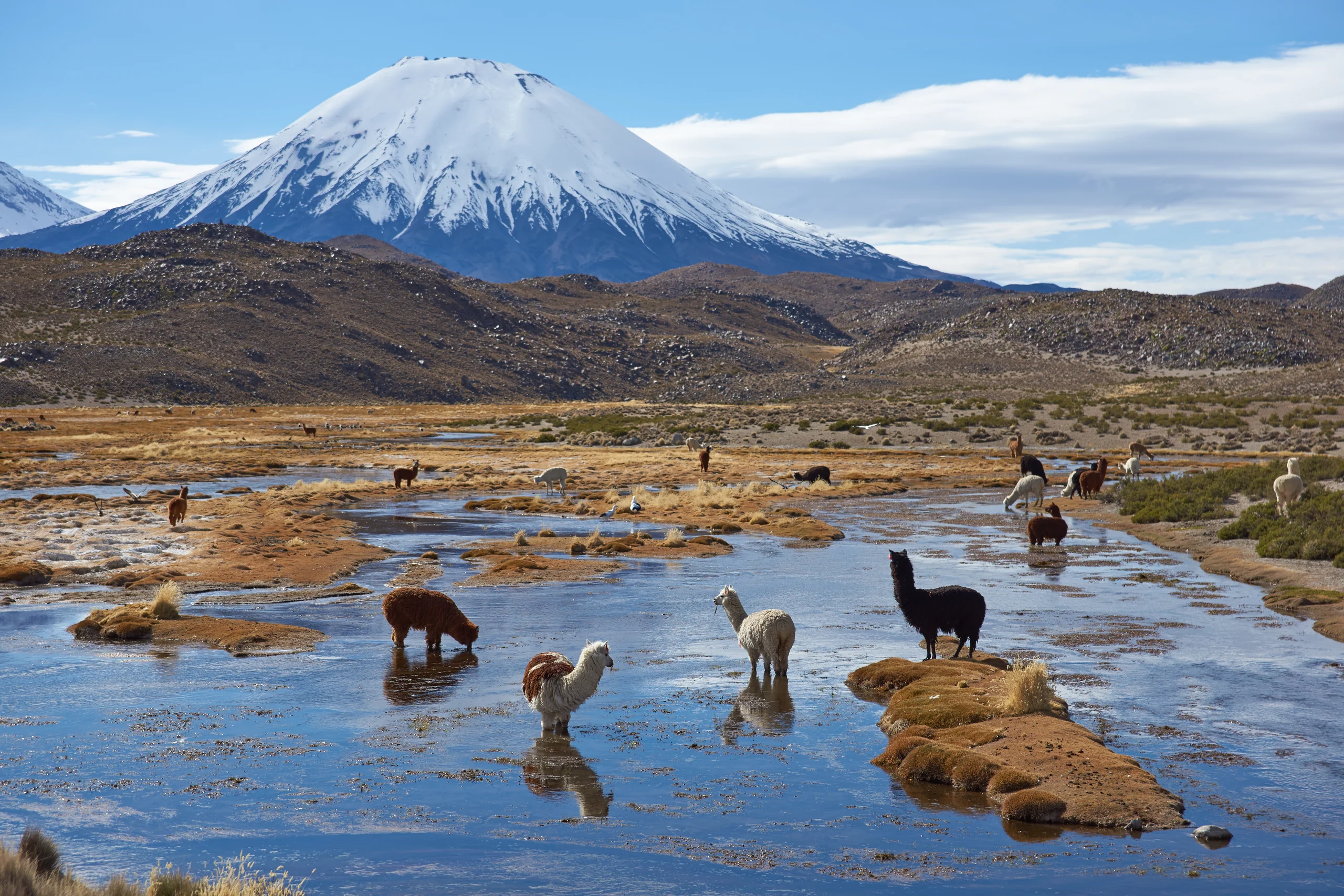
Its crown jewel is Lake Chungará, one of the highest lakes in the world at 4,517 metres, whose impossibly turquoise waters reflect the twin snow-capped cones of the Payachata volcanoes, Parinacota and Pomerape. Herds of wild vicuñas graze on the ichu grass while three species of flamingo wade through shallow lagoons.
Viscachas, rabbit-like rodents with curled tails, sun themselves on the lava rocks, and Andean condors ride the thermals overhead. The park is best visited between April and November when skies are clearest, though even in the Bolivian winter the altiplano light is extraordinary.
Surf, Sand, and Coastal Life
Back at sea level, the coast of Arica y Parinacota offers some of Chile's best surfing. Playa Las Machas and Playa El Laucho are popular with families and swimmers, while the powerful left-hand break known as El Gringo, right beneath the Morro, draws experienced surfers from around the world. The annual Arica Chilean Challenge, held at the legendary bodyboarding wave called El Buey, is one of the most extreme big-wave competitions in the sport.
Beyond the surf, the coastal wetlands of the Lluta River mouth provide critical habitat for migratory seabirds, and the fishing coves of Caleta Vítor and Caleta Camarones offer a glimpse of the artisanal fishing culture that has sustained coastal communities for generations.
Fresh ceviche, sea urchin, and grilled congrio are staples of the local diet, often prepared right at the caleta and served with the region's distinctive spicy ají sauce.
A Crossroads of Flavours and Traditions
The cuisine of Arica y Parinacota is a compelling fusion born from geography. Coastal seafood meets Aymara highland traditions: quinoa, chuño (freeze-dried potato), charqui (dried llama meat), and fresh oregano from the Azapa Valley find their way into dishes alongside Pacific fish and shellfish. The region is also Chile's main producer of olives and olive oil, thanks to centuries-old groves in the Azapa Valley that trace back to the Spanish colonial period.
During the Carnaval Andino con la Fuerza del Sol, held every February, tens of thousands of dancers and musicians from Chile, Peru, and Bolivia flood the streets of Arica in a three-day explosion of colour, music, and dance that rivals the carnivals of Oruro and Barranquilla.
The celebration reflects the region's identity as a cultural crossroads, a place where Chile, Peru, and Bolivia converge not just geographically but spiritually and gastronomically.
Points of Interest
Cities
Cities
Arica
Chile's northernmost city (around 220,000 people), on the edge of the Atacama and some 20 km from the Peruvian border, with a climate so even that it is known as the city of eternal spring. El Morro, the headland above the centre, was stormed by Chilean troops in 1880 and now looks down on the port handling much of Bolivia's trade. Nearby are the Chinchorro mummies, at roughly 7,000 years the oldest deliberately preserved human remains in the world, and the iron church of San Marcos, prefabricated in Gustave Eiffel's Paris workshops.
Natural Reserves
Natural Reserves
Lagunas de Cotacotani
A maze of small lagoons at about 4,500 m, formed when lava and collapsed debris from Parinacota volcano dammed the basin and left dozens of pools between islands of black rock. They are fed by the same underground system as neighbouring Lago Chungará. A viewpoint on the road between Arica and Putre takes in the whole tangle at once.
Hiking · Wildlife · Viewpoint
Natural Reserves
Humedal del Río Lluta
A wetland where the Río Lluta reaches the sea just north of Arica, and one of the few freshwater places along this stretch of desert coast. More than 150 bird species have been recorded, and it is an important resting point for shorebirds migrating south along the Pacific. A boardwalk beside the coast road opens onto the reed beds, and the light is best early in the morning.
Wildlife · Viewpoint · Parking
Natural Reserves
Parque Nacional Lauca
One of Chile's great high-altitude parks, running from 3,200 m up to the 6,342 m cone of Parinacota volcano on the Bolivian border. Lago Chungará lies at 4,517 m below the volcano and is among the highest lakes in the world, with flamingos and giant coots on the water and vicuñas grazing the surrounding bofedales. The village of Parinacota, with its whitewashed 17th-century church, sits inside the park. Treat the altitude seriously: the road climbs from sea level at Arica in a matter of hours.
Hiking · Wildlife · Camping · Viewpoint
Natural Reserves
Monumento Natural Quebrada de Cardones
A ravine on the road climbing from Arica to Putre, protected for its forests of candelabro cactus, which grow in branching columns several metres tall between roughly 2,000 and 3,000 m. The cardón is endemic to this part of the Andes and grows slowly enough that the larger specimens are centuries old. Petroglyphs left by the caravans that used this route lie nearby.
Hiking · Viewpoint
Natural Reserves
Reserva Nacional Las Vicuñas
A reserve above 4,300 m created in 1983, next to Lauca and named for the animal it was set up to protect. Vicuñas were hunted almost to extinction for their wool before protection began in the 1970s; today the herds are a common sight. The track through it is unpaved with no services, so most visitors simply pass through between Lauca and Salar de Surire.
Wildlife · Hiking
Natural Reserves
Monumento Natural Salar de Surire
A salt flat at about 4,200 m ringed by volcanoes, where all three South American flamingo species (Chilean, Andean and James's) breed. Hot springs at Polloquere on the southern shore are open to bathe in, with the salt crust spreading out beyond. Borax is still mined at one end, so trucks share the road with the wildlife.
Wildlife · Thermal baths · Viewpoint