ExploreChileliving unforgettable adventures


Araucanía
Araucanía is the ancestral heartland of the Mapuche people, whose culture, language, and traditions remain vibrantly alive across the region. The landscape is dominated by Volcán Villarrica's near-perfect cone rising above the lakeside resort town of Pucón, while ancient araucaria forests shelter in the national parks.
Audio version available
Pucón, Adventure Capital of Chile
Nestled on the shore of Lake Villarrica with a smoking volcano as its backdrop, Pucón is Chile's undisputed adventure capital. In summer, the town offers an almost absurd density of outdoor activities: summiting the active Villarrica volcano at dawn to peer into its glowing lava crater, white-water rafting on the Trancura River, canyoning through basalt gorges, mountain biking through araucaria forests, zip-lining over native canopy, kayaking on volcanic lakes, and soaking in half a dozen different hot spring complexes fed by the region's geothermal energy.
In winter, the Centro de Ski Pucón on Villarrica's slopes offers skiing and snowboarding with views of the lake below.
Despite its adventure-tourism fame, Pucón retains a relaxed, small-town atmosphere, its main street is only a few blocks long, lined with restaurants serving craft beer, pizza, and curanto, and the lakefront beach fills with families on warm summer evenings.
Conguillío, Forest of the Moon
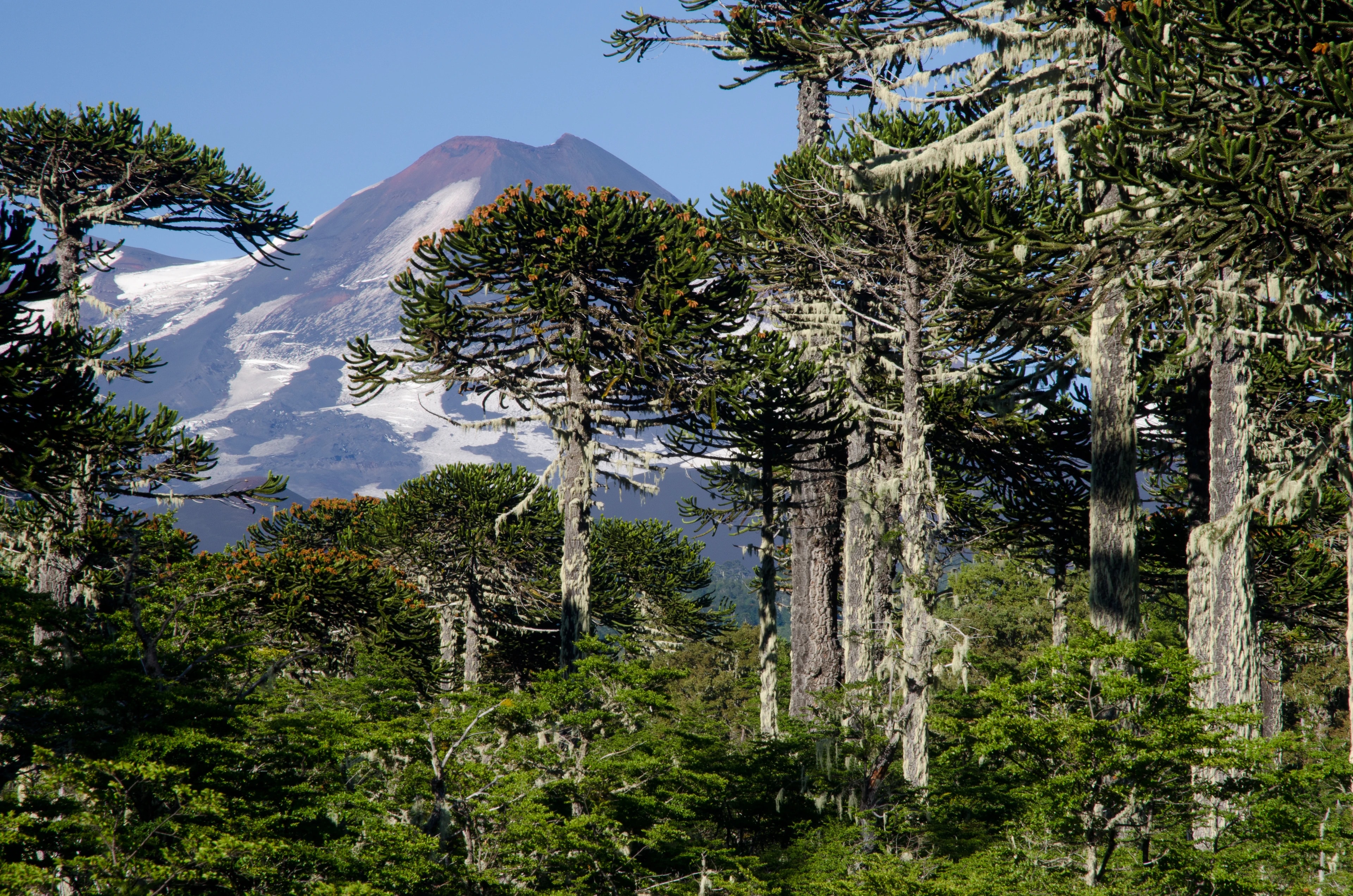
Conguillío National Park is one of Chile's most extraordinary landscapes, a place where ancient araucaria forests rise from fields of black volcanic lava, emerald lakes fill craters, and the towering cone of Volcán Llaima (3,125 m) dominates every vista. The araucaria trees themselves are botanical wonders: towering conifers with umbrella-shaped canopies that have existed as a species for over 200 million years, surviving the extinction of the dinosaurs and the ice ages.
Walking through a grove of mature araucarias, some over 1,000 years old, is like stepping into a prehistoric world. The park's Laguna Conguillio and Laguna Verde shimmer at the base of lava flows, and the Sierra Nevada trail offers a multi-day trek through some of the densest araucaria forest in existence.
National Geographic has called Conguillío one of the most beautiful parks in the world, and a winter visit, when the araucarias are draped in snow against a steel-blue sky, is unforgettable.
Mapuche Culture, A Living Heritage
The Araucanía is the cultural and spiritual heartland of the Mapuche people, Chile's largest indigenous group, who successfully resisted both Inca and Spanish conquest for centuries. The Mapuche language, Mapudungun, is still spoken by hundreds of thousands of people, and traditional practices, from the sacred nguillatún ceremony to the art of textile weaving and silverwork, remain central to community life.
In Temuco, the regional capital, the Feria Pinto market is one of Chile's largest and most vibrant, where Mapuche vendors sell medicinal herbs, handwoven textiles, and traditional foods alongside produce from the surrounding farms. Cultural tourism is growing, with Mapuche communities near Lago Budi, Curarrehue, and Melipeuco offering visitors experiences that include traditional ruka stays, ancestral cooking demonstrations, guided forest walks with ethnobotanical knowledge, and storytelling sessions that convey a worldview deeply connected to the land, the seasons, and the spiritual forces of nature.
Lakes, Hot Springs, and Volcanic Landscapes
The Araucanía sits astride the northern end of Chile's Lake Region, and its volcanic landscape is punctuated by some of the country's most beautiful lakes. Lake Villarrica, the region's largest, is warm enough for swimming in summer and supports a thriving water-sports scene. Lake Caburgua, hidden behind forested hills east of Pucón, is quieter and more pristine, with crystal-clear water and the spectacular Ojos del Caburgua, natural springs where turquoise water wells up through volcanic rock into deep pools.
The Huerquehue National Park, accessible from Pucón, offers day hikes through araucaria and coigüe forest to a chain of alpine lakes perched on a high plateau.
Hot springs are everywhere: Termas Geométricas, a series of 17 slate-lined pools connected by wooden walkways through a forested gorge, is one of the most beautifully designed thermal complexes in the world, while rustic options like Termas de Huife and Termas Los Pozones offer steaming pools beside rushing rivers.
Temuco, Agriculture, and the Frontier Legacy
Temuco, the Araucanía's capital and largest city, is a bustling commercial centre that serves as the gateway to the Lake Region. Founded in 1881 as a military fort during Chile's controversial 'Occupation of the Araucanía,' the city carries the complex legacy of that frontier era, a history of displacement and resistance that continues to shape the region's social dynamics today.
Despite these tensions, Temuco is a dynamic city where Mapuche and Chilean cultures intersect: the Museo Regional de la Araucanía explores both the pre-colonial and colonial history, while the city's restaurants increasingly feature Mapuche-influenced cuisine, dishes with merkén (smoked chilli), piñones (araucaria nuts), and mudai (fermented grain drink).
The surrounding agricultural land is Chile's breadbasket for wheat, oats, and potatoes, and the autumn harvest season fills the roads with tractors and the air with the smell of freshly turned earth.
Points of Interest
Cities
Cities
Temuco
Capital of the Araucanía Region (population around 285,000) and the urban heart of Mapuche Chile. The Feria Pinto fills the city with the smell of merken and smoked horse meat; the Cerro Ñielol park, just behind downtown, preserves a remnant of the native forest where the 1881 treaty with the Mapuche was signed. Pablo Neruda grew up here as the son of a railway worker, an upbringing he describes in 'Memorial de Isla Negra'. Temuco is also the main road, rail and air gateway to the Lake District.
Cities
Villarrica
Lakeside town of around 50,000 on the western shore of Lago Villarrica, with the perfect cone of the active Volcán Villarrica rising across the water. Founded in 1552, destroyed and refounded several times during the Mapuche wars, the modern town carries a clear German-settler imprint in its houses and cuisine. The wide costanera, the Mercado Fritz and the Museo Mapuche y Colonial de Villarrica make it the quieter, more historic counterpart to next-door Pucón.
Cities
Pucón
Chile's adventure-tourism capital (population around 25,000, several times that in summer), spread along the eastern shore of Lago Villarrica at the foot of the Volcán Villarrica. Pucón is the base for the classic ascent of the volcano, white-water rafting on the Trancura, hot-spring circuits around Termas Geométricas and Menetúe, and easy access to the araucaria forests of Huerquehue. The lake's grey-sand beaches, lined with cafés, restaurants and the historic Gran Hotel Pucón, anchor a buzzy summer scene.
Cities
Licán Ray
Quiet lakeside village (population around 2,000, many times that in summer) on the northern shore of Lago Calafquén, in the Araucanía Region. Two short peninsulas, Playa Grande and Playa Chica, give the town its dark-sand swimming beaches, framed by native forest and the cone of Volcán Villarrica in the distance. Out of season Licán Ray empties out and becomes a base for visits to the Coñaripe hot springs and the Siete Lagos circuit.
Natural Reserves
Natural Reserves
Parque Nacional Conguillío
Stunning 60,832-hectare national park (established 1950) dominated by Volcán Llaima and ancient araucaria forests with trees over 1,800 years old. Highlights include Laguna Verde, Laguna Conguillío, and the Sierra Nevada trail. Best visited December to March.
Dec–Mar 8:30–18:00 · Apr–Nov 8:30–17:30 · $5,000 CLP
Hiking · Camping · Wildlife · Viewpoint · Picnic area
Natural Reserves
Parque Nacional Huerquehue
12,500-hectare highland park (established 1967) with a network of trails leading to a string of glacial lakes through araucaria and coigüe forest. Lago Tinquilco anchors the entrance. Best November to April.
Dec–Mar 8:30–18:00 · Apr–Nov 8:30–17:30 · $5,000 CLP
Hiking · Camping · Wildlife · Viewpoint
Natural Reserves
Parque Nacional Tolhuaca
Remote 6,374-hectare park (established 1935) in the Andean foothills, with the Salto Malleco waterfall, hot springs, and one of Chile's best-preserved native forests. Year-round access; expect snow from June to September.
Dec–Mar 8:30–18:00 · Apr–Nov 8:30–17:30 · $5,000 CLP
Hiking · Camping · Wildlife · Viewpoint
Natural Reserves
Parque Nacional Nahuelbuta
6,832-hectare coastal range park (established 1939) preserving the last low-altitude araucaria stands. The Piedra del Águila viewpoint offers panoramas from the Andes to the Pacific. Best December to April.
Dec–Mar 8:30–18:00 · Apr–Nov 8:30–17:30 · $5,000 CLP
Hiking · Camping · Wildlife · Viewpoint
Natural Reserves
Parque Nacional Villarrica
63,000-hectare park (established 1940) covering three volcanoes (Villarrica, Quetrupillán, and the Chilean side of Lanín). Includes the Pucón ski center, glacial caves, and lava-formed lagoons. Open year-round.
Dec–Mar 8:30–18:00 · Apr–Nov 8:30–17:30 · $5,000 CLP
Hiking · Camping · Viewpoint · Ski
Natural Reserves
Reserva Nacional Malalcahuello
32,000-hectare Andean reserve known for its araucaria and lenga forests, the active Lonquimay volcano, and the Corralco ski center. Connected to the adjacent Nalcas reserve. Open year-round.
Dec–Mar 8:30–18:00 · Apr–Nov 8:30–17:30 · $4,000 CLP
Hiking · Camping · Viewpoint · Ski
Natural Reserves
Santuario Cañi
500-hectare private sanctuary established 1991, Chile's first community-run protected area. Visits are guided only and lead to high-altitude viewpoints over Villarrica, Quetrupillán, and a chain of Andean lakes.
Open all year (guided tours only) · $25,000 CLP
Hiking · Wildlife · Viewpoint
Natural Reserves
Geoparque Kutralkura
UNESCO Global Geopark since 2015, spanning 8,100 km² across four communes. The name means 'stone of fire' in Mapudungun and refers to volcanic landscapes, lava tubes, and basalt formations across the Lonquimay basin.
Open all year · Free
Hiking · Viewpoint · Visitor center
Natural Reserves
Termas de Menetué
Thermal complex 30 km east of Pucón with five outdoor pools and a covered spa, set in native forest along the Menetué river.
Daily 10:00–22:00 · $25,000 CLP
Thermal baths · Restaurant · Parking
Natural Reserves
Parque Termal Botánico
Liquiñe-valley thermal park combining indoor and outdoor hot springs with curated gardens of native and exotic flora.
Daily 10:00–22:00 · $25,000 CLP
Thermal baths · Parking
Natural Reserves
Termas de Huife
Historic thermal resort 40 km east of Pucón, in operation since the 19th century, with riverside outdoor pools and a small hotel.
Daily 10:00–22:00 · $35,000 CLP
Thermal baths · Restaurant · Lodging · Parking
Natural Reserves
Termas de Manzanar
Traditional 1930s-era thermal resort in the village of Manzanar near Curacautín, surrounded by araucaria forest on the road to Volcán Lonquimay.
Daily 10:00–22:00 · $20,000 CLP
Thermal baths · Lodging · Restaurant · Parking
Wineries
Wineries
Viña Kütralkura
Viña Kütralkura is a boutique winery founded in 2013 by José Chahín Ananía and his daughter Josefina Chahin Doussoulin in the southernmost reach of Chilean winemaking, La Araucanía. Josefina runs the operation today, and the project carries the line 'a wine made by women from the vineyard to the winery'. The estate is split across two sites. The three hectares of vines sit at the Cutipay sector of Angol, in the Valle del Malleco, planted to Pinot Noir, Chardonnay and Viognier, varieties that thrive in this cold-winter, dry-summer climate with strong day-night swings. The bodega itself sits further south, in the commune of Curacautín at km 10 of the road toward Conguillío National Park, inside the volcanic landscape of the Geoparque Kütralkura that gives the winery its name. The first commercial harvest came in 2018. The vineyard soils are volcanic with clay and limestone deposits that give a noticeable mineral spine. The team trains the vines on espaldera with row-by-row gravitational irrigation, and the bodega is built around sustainability, solar panels for energy and natural cold-winter tartaric stabilisation rather than chemical fining. The portfolio is small and cool-climate by design: Pinot Noir, Chardonnay, Viognier, a Rosé, an Ensamblaje Viognier & Chardonnay, and an Espumante Brut made by the traditional method. Visits are by appointment and coordinated directly through the winery.
By appointment
Wine Tasting · Shop
Wineries
Viña Capitán Pastene
Viña Capitán Pastene, known locally as VICAP, was founded in 2017 by the agronomist-enologist Raúl Narváez and the lawyer and entrepreneur Juan Pablo Lepín, with the explicit aim of putting the Malleco Valley on Chile's serious wine map. The bodega sits in the small town of Capitán Pastene, in the commune of Lumaco, La Araucanía, a settlement founded in 1904 by Italian immigrants from Emilia-Romagna and still recognisably a piece of southern Chile that speaks with an Italian accent, complete with its own protected-origin prosciutto. The estate's first commercial bottle was Los Confines Moscatel de Alejandría, released in 2018 and at the time the southernmost Moscatel produced in Chile. The grapes come from an extraordinary little vineyard, 0.6 hectares planted around 1920 by Italian settlers inside what is today a partially closed prison in Angol. VICAP took the project on as both a wine venture and a social one: inmates work the vines, and the wine helps fund their reintegration. From the same fruit comes Trawa, a skin-macerated Moscatel with greater aromatic intensity, complexity and body. The red side of the house is Nahuelbuta, a Pinot Noir from a 20-year-old, one-hectare plot in Los Sauces, at the foot of the Nahuelbuta range. The colder, wetter climate of Malleco gives the wine the kind of restraint and herbal lift more often associated with Patagonian or European cool-climate sites. Visits are by appointment and built around a guided tour of the vineyards and the modern Capitán Pastene cellar, followed by a tasting of the current range. The bodega is closely associated with the town's annual Fiesta del Vino y Prosciutto, which pairs the local wines with Capitán Pastene's protected-origin prosciutto.
By appointment
Wine Tasting · Tours
Wineries
Viña Don Damián
Viña Don Damián is a family bodega in the Rucatraro sector of Galvarino, on Ruta R650, Malleco Valley, in La Araucanía. The family has been making wine on this land since 1925, when Don Damián, grandfather of the current owner Carlos Muñoz, produced pipeño wine and aguardiente for local sale. Some of the parras planted back then are still bearing fruit today, which gives the project a quiet line of continuity that few wineries in the country can match. Carlos has gradually pulled the bodega into a more contemporary chapter without losing the heart of it. The vineyard now works Semillón, Chardonnay, Chasselas, Pinot Noir and Moscatel de Alejandría, a varietal palette that mirrors the cold-climate identity of Malleco. The wines come out under three labels: Traro and Pellahuén lead the cellar, with the Chilco Don Damián rosé alongside. The approach in the vineyard leans firmly on sustainable agriculture, in line with the broader spirit of the Ruta del Vino de la Araucanía, the small but growing route of southern wine projects that Don Damián is part of. Visits are by appointment and last about two hours. The programme covers a vineyard walk explaining the sustainable practices, a tour of the on-site bodega, a tasting of the current range, and a small food pairing using local produce. The estate is pet-friendly, and the surrounding landscape lends itself to birdwatching, hiking, and, in season, joining in the harvest.
By appointment
Wine Tasting · Shop
Wineries
Viña Trayenko
Viña Trayenko is a small organic Pinot Noir project inside the Mapuche community of Toro Melin, in the Ñielol sector of Galvarino, La Araucanía. The bodega is run by Rosa Pilquinao, a Mapuche woman who carries the project's identity as much as its wine. Trayenko was born around 2013 through an INDAP programme that backed the planting of Pinot Noir on indigenous territory, with the explicit idea of building a wine project that belonged to the community itself. The vineyard is small and worked organically, dedicated entirely to Pinot Noir. From it comes the single estate wine, also called Trayenko, a bright dark-red Pinot with red and black fruit (blueberry, plum), subtle herbal and earthy notes, and the light, balanced frame the cool Araucanía climate gives the grape. What sets the visit apart is that it is, first, a Mapuche cultural experience and, second, a wine experience, the two are inseparable. The programme combines a guided walk through the vineyard with a tasting at the bodega, paired with traditional Mapuche food and conversation about the community's stories and continuity. Cabins on the property, hiking, harvest participation and a small shop of traditional products round out the offer; the estate is pet-friendly. Visits are by appointment and coordinated directly with Rosa via WhatsApp.
By appointment
Wine Tasting
Wineries
Viña Aynco
Viña Aynco was founded in 2014 by three partners in the Sector Capricho of Galvarino, in the Cautín Valley of La Araucanía, the southernmost stretch of Chilean wine country. The first commercial production landed in 2016, and by 2019 the bodega was already exporting to Brazil. The house carries it all under a single line: 'desde La Araucanía al mundo', from La Araucanía to the world. The vineyard is small and the team works with grapes from both the local Cautín ground and the neighbouring Malleco Valley. The varietal palette is firmly cool-climate: Pinot Noir, Chardonnay, Riesling, and Moscatel de Alejandría. Production is deliberately capped at a maximum of 1,500 bottles per varietal each year, in line with the bodega's stated aim of making 'wines that are an honest reflection of their origin', minimal intervention, preserved natural acidity, fresh and authentic. The terroir is volcanic and cold, and Aynco is built to let that come through in the glass: artisanal vinification, no excess, and the kind of restraint these southern soils respond to. Visits are by appointment and come in two formats. The Aynco Esencial experience is about three and a half hours and combines a vineyard walk, a cellar visit, and a guided tasting of four wines. The Aynco 3 Tiempos experience adds a three-course lunch to the same tour and runs to about five hours. Both are limited to small groups.
By appointment
Wine Tasting · Tours · Shop
Wineries
Viña Aires de Menetúe
Viña Aires de Menetúe sits inside the Parque Termal Menetúe, in the Trancura Valley near Pucón, Andean Patagonia, Región de La Araucanía. The project was launched in 2014 by Eugenio Benavente, the owner of the thermal park, and took on a clearer wine identity in 2017 when enologist María Paz Valenzuela came in as project leader and pushed the operation toward serious cool-climate winemaking. The vineyard is just one hectare, planted to three varieties that thrive in this far-southern, lake-facing terroir: Chardonnay, Pinot Noir and Pinot Meunier. The first harvest came in 2021. One of the project's signature innovations is its frost-control system, which uses the thermal water from Menetúe to protect the vines on the coldest spring nights, a unique pairing of the park's geothermal heart and the new vineyard around it. The wines are made with minimal intervention, semi-organic and largely manual, the bodega frames itself as the 'authentic spirit of Andean Patagonia' in liquid form. The lineup is small and precise: the Ilwen 2021 Chardonnay (Ilwen means 'dew' in Mapudungun), naturally clarified and unfiltered; and two traditional-method sparkling wines from 2022, a 100% Chardonnay and a 100% Pinot Meunier. Visits are by appointment and pair tastings with a meal at Restaurante Pehuen inside the Menetúe thermal park; a small wine club rounds out the offering.
By appointment
Wine Tasting
Wineries
Viña Wuampuhue
Viña Wuampuhue is a small, semi-organic family winery in the commune of Carahue, La Araucanía, on a hill of native trees beside the Imperial River. The bodega is run by Isolina Huenulao, a Mapuche Lafkenche woman who started the project in 2013 with the planting of the first Pinot Noir vines on her land. The name 'Wuampuhue' is Mapudungun for 'place of the canoe', a reference to the river that has shaped this territory for centuries. The vineyard is small and worked according to the principles of the Mapuche worldview, semi-organic vinification, irrigation from a nearby stream, weed control by grazing sheep, and solar panels for the electricity in the cellar. Wuampuhue is recognised as the southernmost Mapuche winery in the world with semi-organic production. From this little stretch of Pinot Noir Isolina produced first a still wine and then, in a Chilean first, the first sparkling wine made by a Mapuche woman, a pale-pink Pinot Noir Brut with strawberry, grapefruit, pear and rose, which placed well at the 25th Catad'Or Wine Awards. Alongside the wine she also makes a small cider, golden, fresh, lightly acidic, from the orchard on the same hill. Visits are by appointment and centred on Isolina herself: a guided walk through the vineyard, an explanation of the wine and cider making, a tasting, and a longer conversation about the Mapuche identity of the project. Two cabins on the property, with clay jars, hot tubs and views over the vines, are available for guests who want to stay overnight.
By appointment
Wine Tasting
Scenic Spots
Scenic Spots
Lago Gualletué
Remote Andean lake at 1,100 m elevation considered the source of the Biobío River. Surrounded by araucaria forests and Pehuenche communities, ideal for fly fishing.
Scenic Spots
Laguna de Icalma
Pristine glacial lake on the Argentine border surrounded by ancient araucaria forests. A sacred site for the Pehuenche people, known for trout fishing and wilderness solitude.
Scenic Spots
Laguna Conguillio
Scenic lake within Parque Nacional Conguillío formed by lava flows from Volcán Llaima. Its emerald waters are framed by araucaria forests and volcanic landscapes.
Scenic Spots
Lago Villarica
176 km² lake at the foot of Volcán Villarrica, anchored by the resort town of Pucón and the smaller city of Villarrica. Warm in summer and busy with swimming, sailing, and jet-skiing.
Scenic Spots
Lago Collico
Small, tranquil lake north of Villarrica surrounded by native forest and farmland. A peaceful alternative to its busier neighbours, popular for fishing and kayaking.
Scenic Spots
Lago Caburgua
Crystal-clear lake near Pucón famous for its white-sand beaches and turquoise waters. Nearby Ojos del Caburgua waterfalls are a must-visit natural attraction.
Scenic Spots
Lago Calafquén
Large volcanic lake straddling the Araucanía and Los Ríos regions, known for its warm summer waters and the resort town of Licán Ray on its northern shore.
Scenic Spots
Lago Budi
Chile's only saltwater coastal lake, separated from the Pacific by a narrow sand bar. Home to Mapuche Lafkenche communities and rich birdlife including black-necked swans.
Volcanoes
Volcanoes
Volcano Villarica
One of Chile's most active volcanoes (2,847m), looming over Pucón. Hike to the summit for views into the active crater.
Free
Hiking
Volcanoes
Volcano Sollipulli
Massive ice-filled caldera in the Araucanía Andes (2,282m). The crater holds a 13-square-kilometer glacier, a rare sight in Chile.
Free
Hiking
Volcanoes
Volcano Choshuenco
Glacier-capped stratovolcano (2,415m) on the border of Los Ríos. Backcountry skiing on its flanks during winter.
Free
Hiking
Breweries
Breweries
Cerveza Cráter
Villarrica craft brewery founded in 2007, with 12 house styles, a restaurant, lakeside cabins, and guided brewery tours that walk visitors through the entire production process.
Daily 12:00–23:00
Beer tasting · Tours · Restaurant · Shop · Lodging
Breweries
Cervecería Wenu Pillan
Roadside brewery, restaurant, and bar at km 10 of the Villarrica-Pucón route, with house ales and an outdoor terrace facing the Andes.
Daily 12:00–23:00
Beer tasting · Restaurant · Shop
Breweries
Cerveza Lacustre
Pucón craft brewery built on naturally volcanic-rock-filtered water from the southern Andes. Small-batch production, available by appointment and through local bars.
By appointment
Beer tasting · Shop
Breweries
Biergarten Pucón
Pucón beer bar with a rotating tap list of southern Chilean craft beers, plus pub food and live music nights. A quick stop for sampling the region's small brewers.
Daily 17:00–01:00
Beer tasting · Restaurant